Energy Infrastructure: What It Includes and How It's Changing
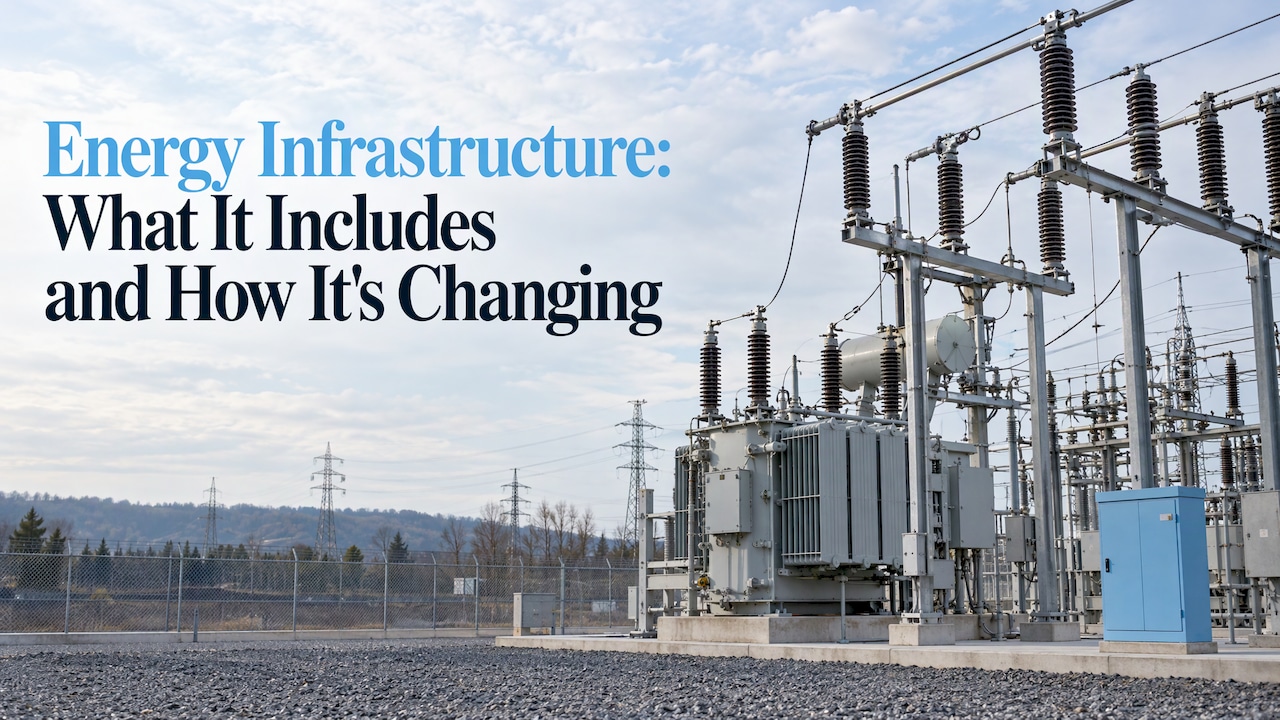
Energy infrastructure is the full chain of physical systems that generate, store, transmit and distribute energy to homes, businesses and industry. For clean energy producers, local organizations and investors, the useful question is not only what the chain contains but where it is under strain, because that is where new projects either connect and get funded or stall. This guide walks through the chain, how renewable sources join it, what policy is doing to it and how verified, transparent project data fits in.
TL;DR
- Energy infrastructure covers generation, storage, high-voltage transmission, local distribution, grid controls and the services that finance and build them.
- Renewables connect at two levels: small distributed systems on the local grid and utility-scale plants on transmission lines. Each has different timelines and costs.
- Grids are now the bottleneck. The IEA says new grid infrastructure often takes five to 15 years to deliver, against one to five years for new renewable projects.
- Policy is shifting fast, so a project’s case should rest on measurable, verifiable impact rather than on one subsidy.
- Our WH2C platform is built for facilities that convert waste into green hydrogen and other sustainable energy: connect, measure, verify and, for local projects, raise funds.
Table of Contents
- What energy infrastructure includes
- How renewable energy infrastructure connects to the grid
- Where renewable energy policy meets infrastructure
- The main challenges: age, speed and investment
- What modern infrastructure means for local development and emissions
- How to prepare a clean energy project for the grid and for funders
- Joining a network of clean energy facilities
- Where energy infrastructure is heading
- FAQ
- Sources
What energy infrastructure includes
The U.S. International Trade Administration describes electricity infrastructure as the equipment and services that carry power from plants (hydro, fossil fuel, nuclear, solar, wind, geothermal and biomass) or from storage systems to residential, commercial and industrial customers. It counts transmission and distribution equipment, EV charging, grid-control technologies and the engineering, procurement, construction, financing, testing and certification services around them.
It helps to think in four layers.
Generation
Most generation relies on turbines: steam, gas, water or wind spinning a magnet inside copper coils. According to a PNNL technical report, solar photovoltaics is the main method that does not use a turbine.
Storage
The same PNNL report explains that energy can be stored mechanically (flywheels, compressed air, pumped hydro), chemically, electrochemically or thermally. Storage matters more as wind and solar grow, because it shifts supply to the hours when people need it.
Transmission
The U.S. Department of Energy’s grid backgrounder splits the electricity supply chain into generation, transmission over high-voltage lines (typically 115 to 765 kV) and distribution below 34 kV. High voltage is cheaper and more efficient over long distances, while lower voltage is safer near homes. A University of Washington brief adds that transformers at substations step voltage up or down.
Distribution
Distribution is the last stretch to the customer. It is also where a growing share of generation now enters: the DOE notes that distributed energy resources such as rooftop solar can feed power back into the grid at the end-user site. So the old picture of one-way flow from big plants to passive customers no longer fits.
The University of Washington brief also lists “balance of plant” items as part of the picture: access roads, buildings and other supporting works. A project developer budgets for those as well as for the generator itself.
How renewable energy infrastructure connects to the grid
Renewable projects join the system in one of two ways, and the choice shapes cost, speed and who has to approve the plan.
Distributed generation. Resources of roughly 5 to 500 kW sit on the distribution grid, often behind the customer’s meter, according to the Resources for the Future explainer on integrating renewables. Rooftop solar, small biogas units and community-scale plants belong here.
Utility-scale generation. The same explainer says centralized plants can produce hundreds of megawatts and connect through transmission lines. They need long lines, substations and a much bigger permitting effort.
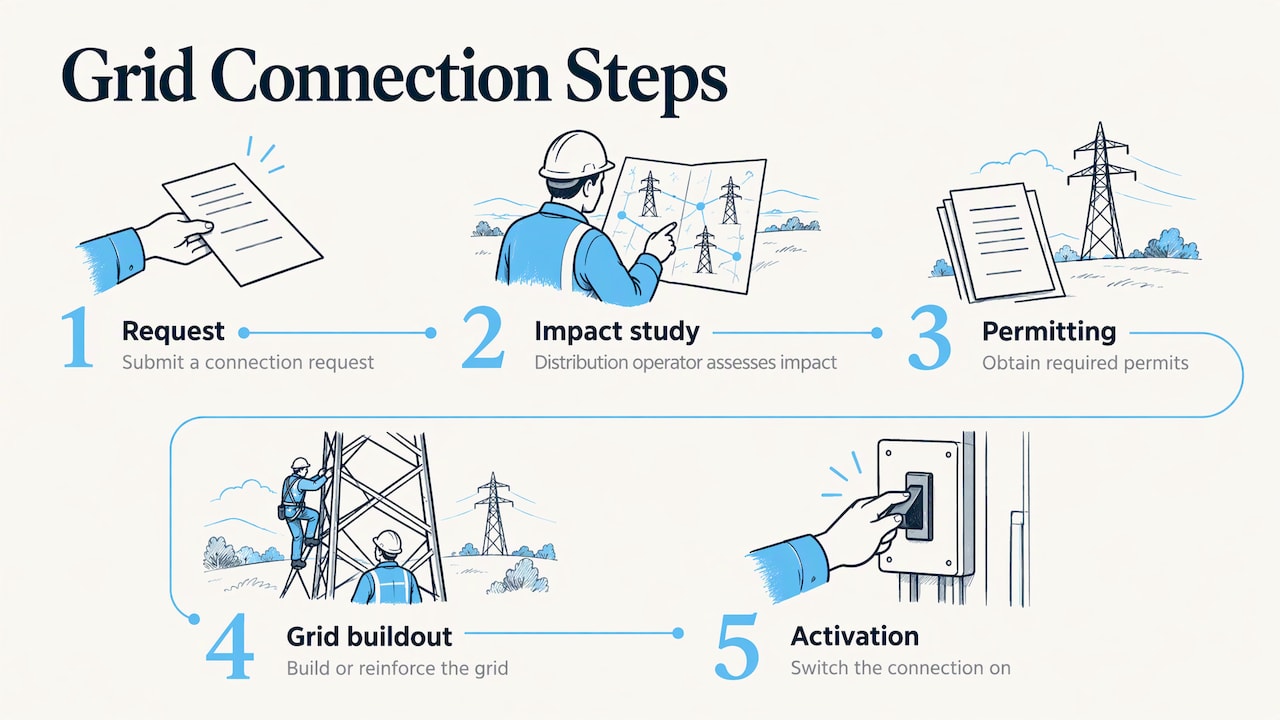
In both cases the physical link is a grid connection. Eurelectric describes the European process as five steps: a request, an impact study by the distribution operator, permitting, grid buildout or reinforcement, and activation. Rules differ by country, and U.S. interconnection runs under its own regional and state procedures, but the shape is familiar to any developer: ask, study, permit, build, switch on.
A second point is that renewables dispatch first. RFF notes that because wind and solar have zero fuel cost, they are the cheapest source at a given moment and get priority. That is good for the economics of a clean project, but it also means the grid must handle swings in supply.
IRENA’s Adrian Gonzalez argues that connecting renewables takes grid assets at both transmission and distribution levels: overhead lines, underground and submarine cables, and substations. Wind and solar are spread across wide areas, so the grid has to expand to deliver power where and when it is needed, and smart grid tools plus storage can steady supply and lower prices.
Where renewable energy policy meets infrastructure
Policy decides which assets get built, who pays and how fast. Three figures from the IEA’s State of Energy Policy 2026 show the scale:
- Governments have earmarked close to $2 trillion for clean energy transitions since 2020, with $1.6 trillion disbursed as of 2025.
- Spending on power generation and grid infrastructure more than doubled since 2015, reaching an estimated $135 billion in 2025.
- Global energy investment rose from about $2.5 trillion in 2019 to an estimated $3.3 trillion in 2025.
The same report records how direction differs by region. China reduced renewables subsidies and phased out feed-in tariffs for new projects in 2025. The United States enacted legislation in July 2025 to end solar and wind tax credits for new projects starting in 2026. The UK allocated a record $56 billion to the Low Carbon Contracts Company in 2025.
For a U.S. reader, the takeaway is practical. Federal support for some technologies is narrowing, and regulation is split: the ASCE’s 2021 Infrastructure Report Card notes that the federal regulator FERC oversees the transmission system, while states regulate the distribution “last mile.” A project therefore answers to several authorities, and its business case holds up best when it shows measured results (tons of waste processed, energy produced, emissions avoided) that any funder, regulator or community can check.
If you want the wider policy picture, the IEA’s Energy Technology Perspectives 2026 tracks deployment, manufacturing, project pipelines and investment for clean energy technologies, and IRENA’s REmap roadmaps assess renewable potential country by country across power, heating, cooling and transport. IRENA’s 2026 report on new power systems looks at how planning, regulation, market mechanisms and financing can support systems where variable renewables dominate.
The main challenges: age, speed and investment
Three problems recur in every serious assessment.
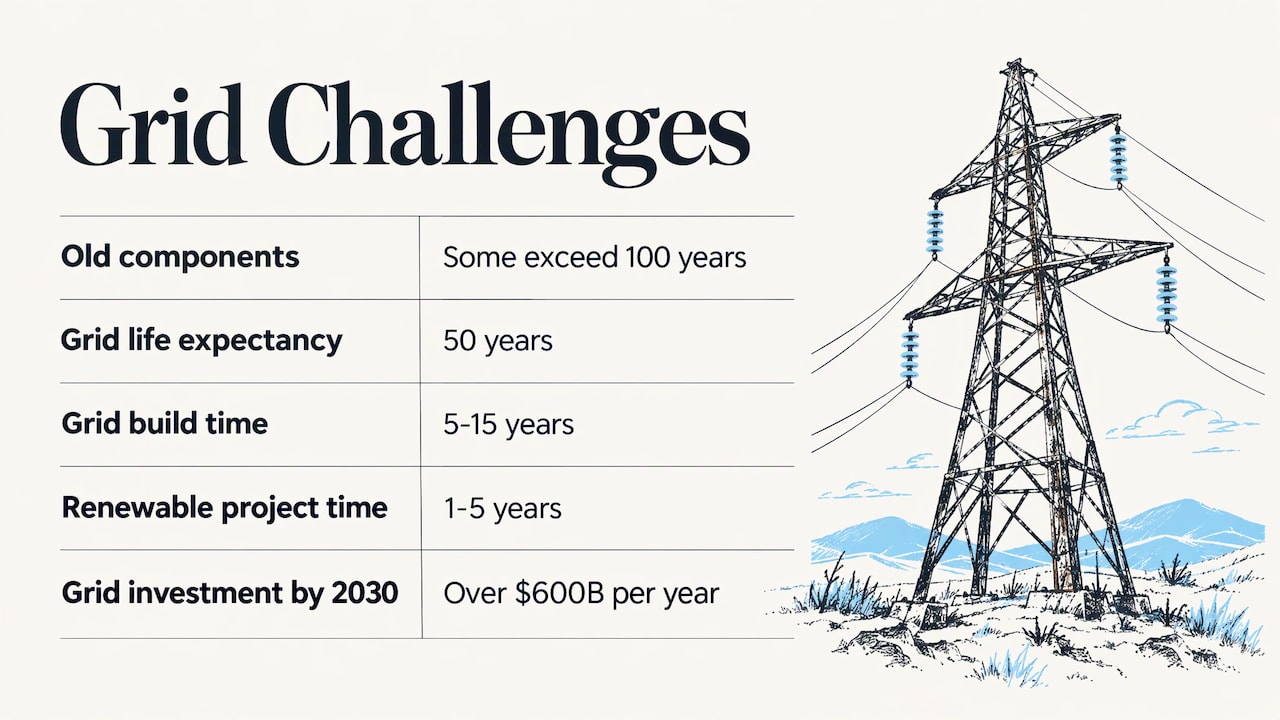
Aging assets. The ASCE reports that most of the U.S. grid is aging, with some components more than a century old and far beyond a 50-year life expectancy.
Slow build times. The IEA’s Electricity Grids and Secure Energy Transitions finds that new grid infrastructure often takes five to 15 years to plan, permit and complete, against one to five years for new renewable projects. Generation can outrun the wires that serve it.
Underinvestment. The same report says global grid investment needs to nearly double by 2030, to over $600 billion a year, after a decade of stagnation. It also warns that emerging and developing economies outside China have seen grid investment decline despite strong demand growth, while advanced economies have grown steadily but still need to step up.
The IEA concludes that delay means prolonging reliance on fossil fuels, with higher emissions and societal costs, and calls for action across investment, regulation, planning, supply chains, digitalization and skilled workforces.
What does this mean for a producer? Where the grid is slow to expand, projects that generate and use energy close to where waste is produced become more attractive. They place less load on distant lines, and they bring benefits to the host community directly.
What modern infrastructure means for local development and emissions
Big transmission lines get the headlines, but local projects are where communities feel the change. A facility that turns local waste into green hydrogen or other sustainable energy does three things at once: it handles a waste stream, it produces energy near its users, and it cuts the emissions tied to both.
The obstacle for such projects is usually not the idea. It is proof and funding. Lenders, municipalities and neighbors want to know what a plant actually produces and what it avoids, and they want to see it in numbers they can trust. A small plant also rarely has the access to capital that a utility-scale developer has.
That is the gap a measurement-first platform addresses. Verified production data turns a plant’s claims into quantifiable results, and a crowdfunding route lets people near the project take part in financing it. This is the model we build around.
How to prepare a clean energy project for the grid and for funders
Whether you operate a plant or are a local organization starting one, the sequence below keeps a project moving.
- Define the energy output and the waste input. Know what the facility will produce, in what units, and from which waste stream.
- Decide the connection route. A small system on the distribution grid follows a different path from a plant that needs a transmission link. Contact your local utility or regulator early, since the study and permitting step is where most delay sits.
- Plan for the supporting works. Roads, buildings and storage count toward the budget, as the infrastructure brief above makes clear.
- Track production from day one. Records that are measured and verified are far easier to present to lenders, regulators and the public than estimates written later.
- Line up funding that does not hinge on one subsidy. With support schemes changing in several countries, diversified financing is a safer base.
- Tell the community what the project avoids. Emissions reduced and waste diverted are the numbers that win local backing.
Steps 4 and 5 are where we can take work off your hands: the WH2C platform lets facilities connect, measure and verify their impact with blockchain-based production tracking, and offers a crowdfunding solution for green energy plant projects.
Joining a network of clean energy facilities
We built the White Hydrogen Coalition’s WH2C platform as an open platform for green energy producers, so facilities that turn waste into green hydrogen and other sustainable energy can connect, measure their impact and reduce their carbon footprints. Production is tracked through verified processes on a blockchain, which is meant to give transparency and quantifiable results. Local projects can also use our blockchain-based crowdfunding to fund a plant.
Our Plant Starter program and the White Hydrogen Coin (WH2C) are part of the same ecosystem. If you operate a facility, lead a local project or want to back one, start at whiteh2coin.com.
Where energy infrastructure is heading
The direction is clear even when the policies are not. Grids will carry more variable generation, storage will take a larger role, and more power will come from sources close to the people who use it. IRENA’s Gonzalez says grid and storage readiness has been overlooked in several regions and that tripling renewable capacity by 2030 depends on urgent grid investment. Eurelectric makes a parallel case for distribution grids: they sit between transmission lines and final customers and must manage load that shifts with weather, time of day and economic activity.
For producers, local organizations and investors, that points to the same conclusion. Projects that are easy to verify, built close to demand and open to local participation fit where the system is going. Start by documenting what your facility produces and avoids, and the rest of the case becomes much easier to make.
FAQ
What is energy infrastructure in simple terms?
It is everything needed to make energy and get it to users: power plants and renewable generators, storage, high-voltage transmission lines, local distribution networks, substations and grid controls. It also includes services such as engineering, financing and certification that make those assets possible.
What is the difference between transmission and distribution?
Transmission moves bulk power over long distances on high-voltage lines, typically 115 to 765 kV according to the U.S. Department of Energy. Distribution carries lower-voltage power, below 34 kV, from substations to homes and businesses. Small distributed generators connect at the distribution level.
Why does renewable energy need new infrastructure?
Wind and solar are spread across wide areas and vary with weather, so the grid needs new lines, substations, storage and smart controls to deliver their output when and where it is needed. The IEA says global grid investment must nearly double by 2030 to over $600 billion a year to meet national climate targets.
How do renewable energy policies affect project plans?
Subsidies, tax credits and tariffs change by country and over time. The IEA records that the United States enacted legislation in July 2025 ending solar and wind tax credits for new projects from 2026, while the UK raised its contract support. Projects with measured results and diversified funding are less exposed to any single change.
How can a local project raise money for a clean energy plant?
Start with documented production and impact data, then combine funding sources. Our WH2C platform includes a blockchain-based crowdfunding solution for green energy plant projects, so local supporters can help finance a facility whose results are tracked and verified.
Sources
- Electricity Infrastructure, U.S. International Trade Administration
- How It Works: Electric Transmission & Distribution, U.S. Department of Energy (2023)
- Generating, Using, and Storing, PNNL (2023)
- MSCE in Energy Infrastructure brief, University of Washington
- Renewables 101: Integrating Renewable Energy Resources, Resources for the Future
- What are grid connections and how Europe can fix the queue, Eurelectric (2026)
- Grid and storage readiness, IRENA (2025)
- Why the distribution grid must be a critical enabler, Eurelectric (2024)
- Government energy spending, State of Energy Policy 2026, IEA
- Electricity Grids and Secure Energy Transitions, IEA (2023)
- Energy Infrastructure, ASCE 2021 Infrastructure Report Card
- Energy Technology Perspectives 2026, IEA
- Renewable energy roadmaps, IRENA
- Solutions for building a new power system, IRENA (2026)