Hydrogen Production Costs: What Drives the Price per Kilogram
Hydrogen production costs range from about $1/kg for natural gas reforming to roughly $5–7/kg for electrolysis-based clean hydrogen in the United States, according to a CSIS analysis from 2025. The gap comes down to a few inputs: fuel or electricity, equipment, financing and how many hours a plant runs. Projects that measure those inputs and prove their production are the ones that can show investors and local partners a credible cost per kilogram. That is the idea behind the WH2C platform, which connects clean energy facilities, tracks production on a blockchain and supports crowdfunding for local plants.
TL;DR
- In the US, reforming of natural gas costs about $1/kg, reforming with carbon capture about $1.8–2.2/kg, and electrolysis-based clean hydrogen about $5–7/kg (CSIS, 2025).
- Green hydrogen cost depends mainly on renewable electricity price, electrolyzer cost and performance, and cost of capital (ICCT).
- Operating hours matter: with few running hours, capital cost dominates the price per kilogram (IRENA, 2020).
- Electrolysis costs are projected to fall from €5.3/kg in 2020 to €4.4/kg in 2030 and €2.7/kg in 2050 (Frieden and Leker, 2024).
- Verified production data makes a project’s cost and impact easier to present to funders.
Table of Contents
- What hydrogen costs per kilogram by pathway
- What drives the cost of green hydrogen
- What drives the cost of fossil-based hydrogen
- How levelized cost of hydrogen is calculated
- How regional differences change the picture
- Where costs are heading
- Turning cost data into a fundable project
- FAQ
- Sources
What hydrogen costs per kilogram by pathway
Hydrogen is sold and compared in dollars per kilogram (kg). The color names describe how it is made: grey from natural gas, blue from natural gas with carbon capture, green from water split by renewable electricity.
| Pathway | Reported cost | Region and source |
|---|---|---|
| Natural gas reforming (SMR) | about $1/kg | US, CSIS |
| Reforming with carbon capture | about $1.8–2.2/kg | US, CSIS |
| Electrolysis-based clean hydrogen | about $5–7/kg | US, CSIS |
| SMR without / with capture | $1.06 / $1.54 per kg | US DOE NETL cases, GasifiPedia |
| Coal gasification without / with capture | $2.58 / $2.92 per kg | US DOE NETL cases, GasifiPedia |
| SMR, 2024 average | €3.3/kg | Europe, European Hydrogen Observatory |
| Grid electrolysis, 2024 average | €7.4/kg | Europe, same report |
| Renewable-direct electrolysis, 2024 average | €6.7/kg | Europe, same report |
Three things stand out. First, US fossil-based hydrogen is cheap because US natural gas is cheap. Second, the same technology costs far more in Europe, where gas and carbon prices are higher. Third, a University of Michigan factsheet reports that green hydrogen cost $4.33–6.05/kg in 2024, down from $7.5/kg in 2020, with a DOE target of $2/kg by 2026 and $1/kg by 2031.
Electrolysis is under 1% of US hydrogen production today, and CSIS expects the 45V clean hydrogen tax credit to bring its cost to $2–4/kg in the near term. Tax credit rules can change, so check the current Treasury and IRS guidance before building it into a financial model.
What drives the cost of green hydrogen
The International Council on Clean Transportation (ICCT) names three key factors: the cost of renewable electricity, the cost and capability of the electrolyzer, and the cost of capital. Each is worth understanding on its own.
Electricity
For on-site green hydrogen, IRENA finds renewable electricity is the largest single cost component, and that green hydrogen is two to three times more expensive than blue hydrogen in most locations. Low electricity cost is a necessary condition for competitive green hydrogen. That is why the best sites matter. A 2026 global study in Energy & Environmental Science found that in 2024 off-grid hydrogen from PEM electrolyzers (a common electrolyzer type) generally cost €3.3–6.0/kg. Only parts of North Africa, the Middle East, Australia and southern South America reached €2.0–2.7/kg.
Electrolyzer cost and efficiency
ICCT’s central scenario has alkaline electrolyzer costs falling from $1,163/kW in 2020 to $634/kW in 2050, with efficiency rising from 70% to 80%. Estimates for 2050 across research groups range widely, from $100/kW to $1,200/kW. That spread is a reminder that equipment cost forecasts are assumptions, not guarantees.
Cost of capital
Electrolysis plants are capital heavy, so the interest rate on the money matters as much as the equipment. The IEA’s regional cost chart, for example, assumes a 5% cost of capital. A project that pays much more for financing will see a higher cost per kilogram from the same plant. This is where local funding structures, such as community or crowdfunded capital, enter the picture.
Operating hours
When a plant runs few hours, fixed investment is spread over less hydrogen. IRENA notes this is the case when using only curtailed electricity or solar without storage or backup. Running more hours lowers capital cost per kilogram, but the electricity then has to be available and cheap at those hours.
Scale
An Australian project’s public feasibility report (Edify, 2025) says its operating costs were high mainly because of small scale. It expects a project two to three times larger to have comparable operating costs with more hydrogen produced. The same report put the levelized cost at A$26–33/kg for a plant making 1,066,000 kg a year, and blamed higher capital costs on inflation, unfavorable exchange rates, added scope and equipment price declines that did not happen. Small plants should model scale and capex risk carefully.
What drives the cost of fossil-based hydrogen
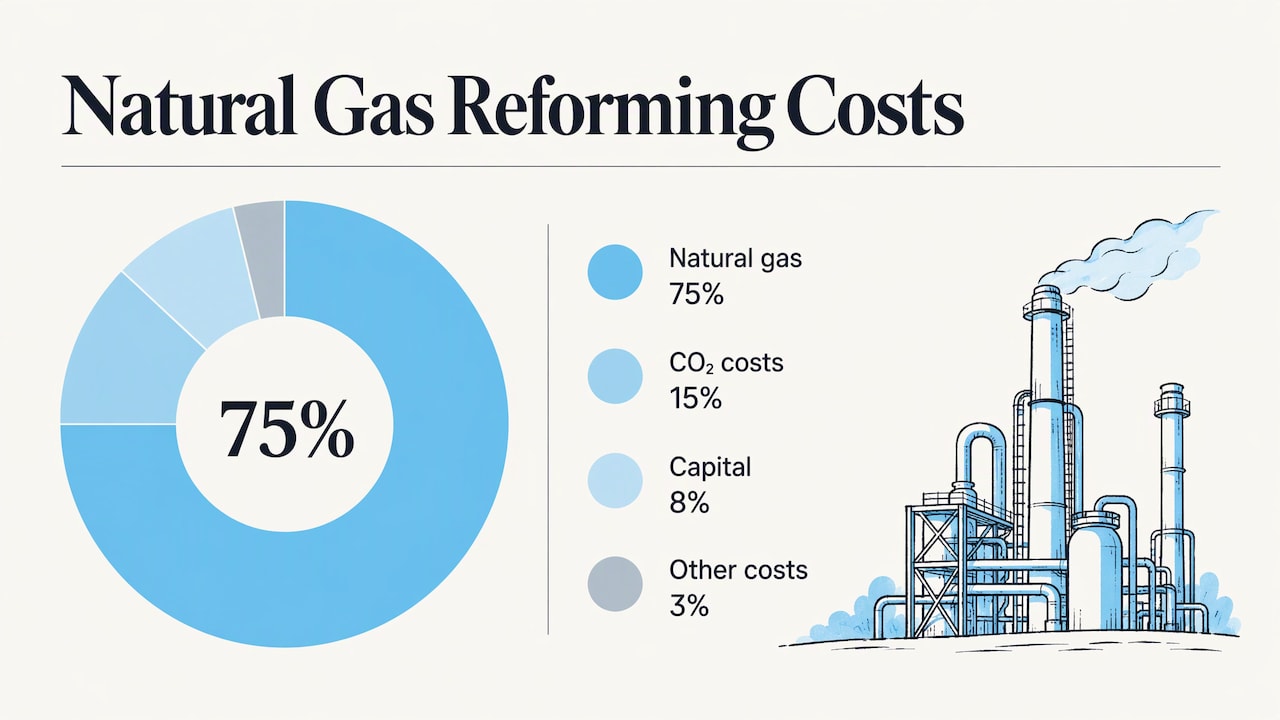
For natural gas reforming, fuel is the main expense. The European Hydrogen Observatory reports that in 2024 natural gas made up about 75% of the total SMR cost, CO2 costs 15%, capital 8% and other operating costs 3%. The IEA puts fuel at 45–75% of production cost, which is why regions with low gas prices, such as the Middle East, Russia and North America, have the lowest costs.
Adding carbon capture changes the figure. The University of Michigan factsheet reports that refitting SMR with carbon capture raises costs by 150%.
How levelized cost of hydrogen is calculated
When two plants quote different prices, check whether they use the same method. The standard measure is the levelized cost of hydrogen (LCOH). A US DOE-supported study defines it as annualized capital costs plus fixed and variable operation and maintenance, including electricity, replacement of materials and equipment, and water, divided by annual hydrogen production in kilograms. The result is dollars per kilogram.
A worked example shows how inputs move the result. A 2026 technical document for China’s chemical sector assumed a total electrolyzer capex of USD 600/kW, 2% annual operating costs, a 10% discount rate, 50.0 kWh of energy per kilogram and electricity at USD 26.57/MWh. It then ran 4,000, 6,000 and 8,000 full-load hours. Changing only the hours changes the answer, because the same capital is spread over a different amount of hydrogen.
When you compare quotes, ask the same questions each time:
- What cost of capital and project life were assumed?
- How many full-load hours per year?
- What electricity price, and is it grid, direct renewable or curtailed power?
- Are compression, storage, water and stack replacement included?
- What year and currency are the figures in?
How regional differences change the picture
Region changes cost through gas prices, electricity prices and financing. The IEA’s 2025 review material concludes that in regions that currently import and face high gas prices, renewable hydrogen could become competitive by 2030. Also from the 2026 global study: in the ICCT’s 2030 analysis, direct renewable connection is cheaper in 74% of US regions, while grid power purchase agreements are cheaper in 26 of 27 EU Member States.
By 2050, under a 1.5°C scenario, the best off-grid sites reach €2.0–2.7/kg while the global median is about €3.7/kg. For a local producer, the practical lesson is to model your own site’s electricity and hours, not a global average.
Where costs are heading
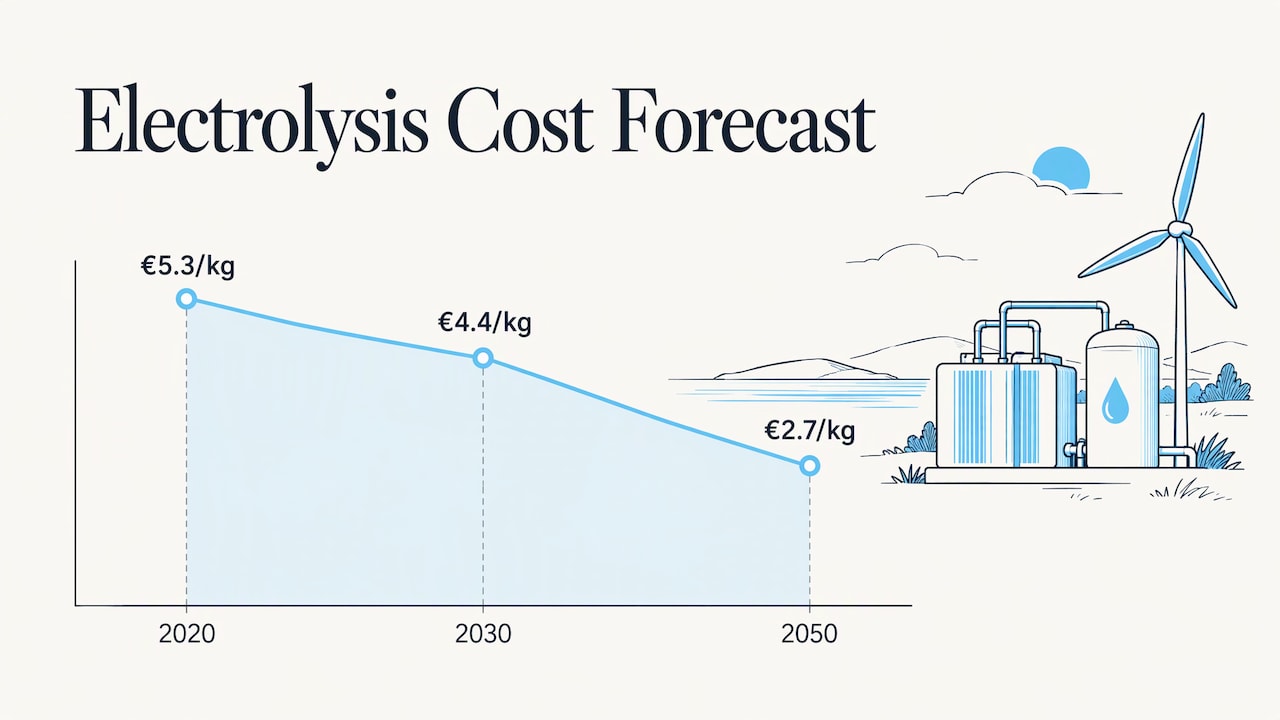
The 2024 review by Frieden and Leker analyzed 89 studies and 832 forecast data points. It finds electrolysis hydrogen on a main path from €5.3/kg in 2020 to €4.4/kg in 2030 and €2.7/kg in 2050, with natural gas-based hydrogen nearly constant. In 2050, Asia has the lowest average regional cost at €1.8/kg and alkaline electrolysis, at €2.0/kg, is the most cost-effective electrolysis technology.
The near-term gap is shaped by markets. The IEA’s Global Hydrogen Review 2025 says lower natural gas prices since 2022–23, plus higher electrolyzer costs from inflation and slower deployment, widened the cost gap, and it expects the gap to narrow by 2030. Gas prices and equipment prices move constantly, so treat any single figure as a snapshot of its year.
Turning cost data into a fundable project
Cost per kilogram is only half of what a funder or local partner wants to see. The other half is evidence: how much hydrogen the plant actually produced, from what input, with what footprint. Operators that can show measured production find it easier to defend their assumptions on hours, efficiency and output, the very inputs that move LCOH.
The WH2C platform is built for that. It lets clean energy facilities that convert waste into green hydrogen and other sustainable energy connect, measure their impact and verify production, with blockchain-based tracking. The Plant Starter program and the crowdfunding solution for green energy plant projects are aimed at local projects looking for funding, with quantifiable environmental results. Pricing is not published, so the next step is to look at the WH2C platform and see how your facility or project would fit.
For investors, the same verified data supports a more grounded reading of a project’s numbers. For local organizations and activists, it gives a way to see what a plant delivers beyond a headline price.
FAQ
How expensive is it to produce hydrogen?
It depends on the pathway and region. In the US, natural gas reforming costs about $1/kg, reforming with carbon capture about $1.8–2.2/kg, and electrolysis-based clean hydrogen about $5–7/kg, per CSIS. European averages for 2024 were higher across the board.
What is the biggest cost in green hydrogen?
For on-site production, renewable electricity is the largest single component, according to IRENA. Electrolyzer capital cost and financing come next, and capital dominates when the plant runs few hours.
What does levelized cost of hydrogen mean?
It is the annualized capital cost plus fixed and variable operating costs, divided by annual hydrogen output in kilograms, as defined in a DOE-supported study. It lets you compare projects on one dollars-per-kilogram basis.
Will green hydrogen get cheaper?
Most forecasts say yes. A 2024 review projects electrolysis costs of €4.4/kg in 2030 and €2.7/kg in 2050, with the pace depending on electricity prices, equipment costs and financing.
Sources
- Understanding 45V and Clean Hydrogen’s Importance for US Energy Leadership (CSIS)
- The European hydrogen market landscape (European Hydrogen Observatory)
- Technologies for Hydrogen Production (US DOE NETL GasifiPedia)
- Future costs of hydrogen: a quantitative review (RSC)
- Hydrogen factsheet (University of Michigan)
- The price of green hydrogen (ICCT)
- Green hydrogen cost reduction (IRENA)
- Global cost drivers and regional trade-offs for low-carbon fuels (Energy & Environmental Science)
- Edify Green Hydrogen Project FEED final report (ARENA)
- Indicative production costs for hydrogen via electrolysis (IEA)
- The Future of Hydrogen (IEA)
- Global Hydrogen Review 2025 webinar (IEA)
- Global Hydrogen Review 2025 (IEA)
- Methods Identifying Cost Reduction Potential for Water Electrolysis (OSTI)
- Renewable hydrogen for chemical sector decarbonisation in China (Agora Industry)
More articles
Renewable Energy Asset Management: A Practical Guide
What renewable energy asset management covers, which KPIs matter, how data platforms help, and why verified production data is the base of every decision.
Energy Infrastructure: What It Includes and How It's Changing
Energy infrastructure explained: generation, storage, transmission and distribution, how renewables plug in, what policy shifts mean, and where local projects fit.