Renewable Project Platform: What It Does and How to Choose
A renewable project platform is a shared digital workspace where project teams, operational data, funding and impact results sit in one place instead of in spreadsheets and email threads. For clean energy producers and local organizations, the strongest platforms do three things: they track a project from idea to operation, they keep production data trustworthy, and they connect projects to the people who can finance them. The White Hydrogen Coalition built the WH2C platform around that idea: an open network where facilities that turn waste into green hydrogen and other sustainable energy can connect, measure their impact and verify it.
TL;DR
- A renewable project platform covers more than scheduling: it ties together development, funding, operations and impact reporting.
- Look for role-based access, strong data security, reporting you can show to funders, and support for the technology you actually run.
- Verified production data is what turns a climate claim into a quantifiable result that funders and communities can rely on.
- Funding access is part of the job: public platforms have matched projects with financiers, and crowdfunding gives local projects another route.
- The WH2C platform combines blockchain-based production tracking, a carbon footprint reduction ecosystem and a crowdfunding solution for green energy plant projects.
Table of Contents
- What a renewable project platform is
- How a platform supports a project from planning to operation
- Features that matter for producers and local organizations
- Connecting teams, operational data and impact measurement
- Why funding access belongs on the platform
- The wider picture: why measurable projects matter
- Waste-to-hydrogen projects and verified tracking
- How to choose: a short checklist
- Where the WH2C platform fits
- FAQ
- Sources
What a renewable project platform is
The phrase covers several tools that are easy to confuse. It helps to separate them by the question each one answers.
Planning and screening tools answer “where and whether?” Natural Resources Canada describes RETScreen Expert as an all-in-one clean energy management platform for planning, implementation, monitoring and reporting, with a free viewer mode. IRENA’s Global Atlas lets users overlay more than 700 maps of solar, wind, bioenergy, geothermal, hydropower and marine resources to screen areas of opportunity.
Data and map tools show potential. A U.S. national laboratory guide published through OSTI explains that most map-based tools cover resource and technical potential, while economic and market potential are largely left to policymakers and project teams. That gap is where a project platform starts: after the map says a site could work, someone has to build, fund and run it.
Project and operations platforms manage the work itself: permits, contracts, construction, subscriber or customer records, production data and reporting. In community solar, the U.S. Department of Energy reports that platforms grew in less than a decade from a short list of innovators to a growing array of providers working across nearly two dozen state markets.
Marketplace and investment platforms connect projects with money. IRENA’s Project Navigator and Sustainable Energy Marketplace facilitated access to finance for 79 projects in 24 African countries, and structure each project’s life cycle into phases with technical guidelines for onshore wind, solar PV, woody biomass, small hydropower, mini-grids and solar home systems.
A complete renewable project platform draws on all four. It does not need to replace every specialist tool, but it should give the producer, the local organization and the funder one version of the facts.
How a platform supports a project from planning to operation
The clearest picture of an end-to-end approach comes from a large developer. Iberdrola’s ANTARES platform, created in 2022, digitalizes the renewable development life cycle from site identification to commissioning. It has modules for opportunities, projects, pipeline, investment plan and business insight, and it handles development tasks such as land management and permitting, then construction tasks such as monitoring and commissioning follow-up.
You do not need a utility-scale budget to take the lesson. A project platform earns its place at each stage:
- Development. Sites, permits, land agreements and feasibility data live in one record, so a new team member can see where a project stands without asking around.
- Funding. The same record feeds the case for financiers: costs, timeline, expected output and environmental benefit.
- Construction. Milestones and contractor handovers are tracked against the plan.
- Operation. Production data flows in continuously, and reports are generated from it rather than assembled by hand.
The Iberdrola team describes the hardest part as standardizing a process that differs across more than 20 countries, with different consents, permitting rules, languages and cultures, without removing local management autonomy. Their answer is a single source of information with a data structure that adapts to each country. The same principle applies to any network of sites: one shared structure, local detail on top.
Features that matter for producers and local organizations
The DOE’s community solar primer is written for solar, but its checklist applies to any renewable platform. Its advice maps neatly onto what a producer or local group should look for:
- Data management, analysis and reporting. Costs, financial performance, enrollment or customer records, and impact reporting both per participant and in aggregate.
- Role-based access. The primer argues that data security is perhaps the biggest driver of the shift to cloud platforms: giving each user appropriate, and only appropriate, access to a large body of data allowed the sector to scale and largely replaced spreadsheets.
- Security credentials. The same primer advises checking for state- or industry-sponsored security certifications and audits, and reviewing the third-party tools embedded in a platform.
- A walkthrough of permissions. It suggests asking for an online tour that shows how user permissions are assigned and balanced against ease of use.
To those, add three questions specific to clean energy producers:
- Does it support your technology? Waste-to-hydrogen, biogas, solar, wind and small hydro each produce different data. An open platform that supports multiple renewable technologies saves a mixed portfolio from running several systems.
- Can the numbers be verified? Reporting is only as good as the data behind it. Production records that cannot be altered after the fact give funders and communities more confidence than a figure typed into a report.
- Does it reach funders? A platform that stops at internal tracking leaves the hardest problem, financing, to someone else.
Connecting teams, operational data and impact measurement
Most projects collect three kinds of information that rarely meet: what the team is doing, what the plant is producing, and what environmental difference that production makes. When they stay apart, impact claims become estimates written at the end of the year.
A connected platform links them. The plant’s output feeds a record, the record is tied to a defined method for calculating avoided emissions, and the result appears in a report that the team, the community and the funder all see. This is where renewable project monitoring and reporting becomes a practical discipline rather than a paperwork exercise: the closer the measurement is to the source, the less there is to dispute.
Impact measurement also benefits from using agreed indicators. The Global Energy Alliance for People and Planet explains in its 2023 report that it uses existing internationally agreed indicators where possible to reduce the burden on partners, and either validates partners’ methods through due diligence or produces its own projections with an independent monitoring partner. The same report estimates 147,000 cumulative tons of CO2e reduced or avoided through its Impact Dashboard, and notes that early carbon impacts are modest but grow because they accumulate across project lifecycles.
Two habits follow from that:
- Pick the measurement method before the plant is running, so the first month of data already counts.
- Report in the same units every period, so a small project’s results can be added to a network’s totals.
Why funding access belongs on the platform
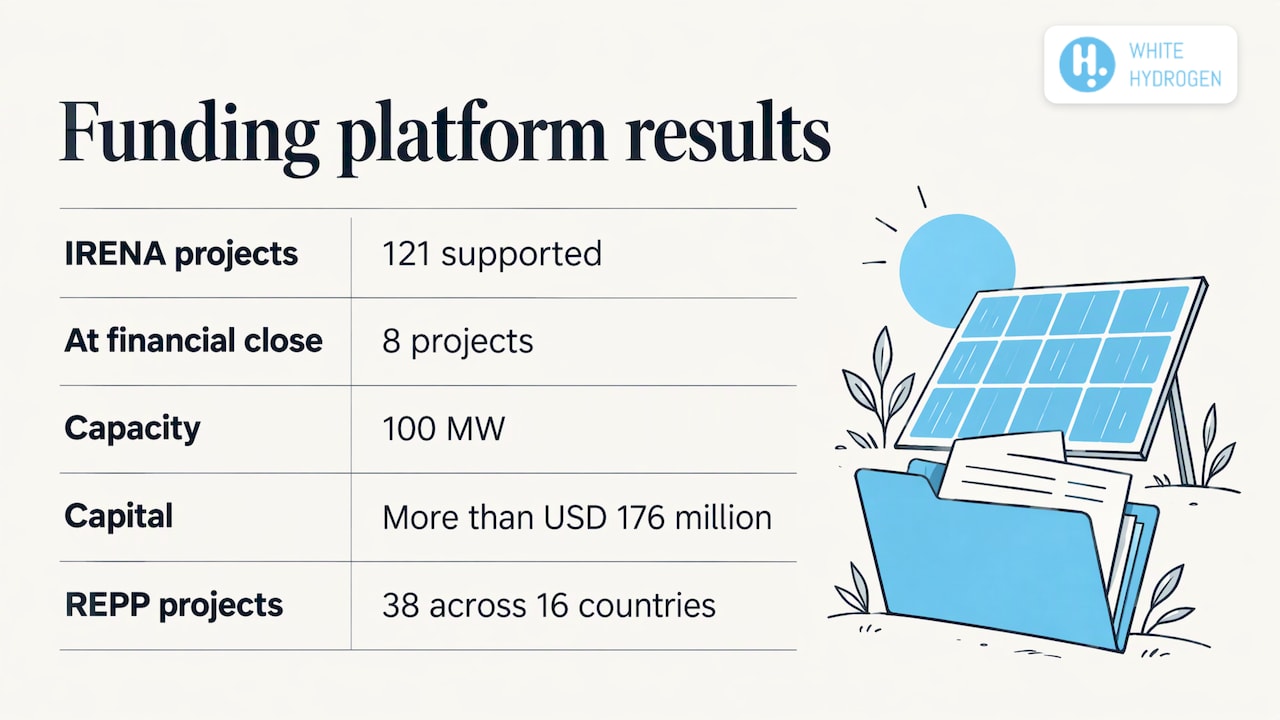
Good projects stall for lack of capital more often than for lack of technology. That is why public bodies have built matchmaking into their platforms. IRENA’s annual report for 2024-2025 describes how its Clean Energy Investment Platform lets proponents pitch directly to financiers at regional forums, receive feedback in real time and refine proposals to improve bankability. The platform supported 121 projects, with eight reaching financial close, totaling 100 MW and more than USD 176 million in capital.
In Africa, the Renewable Energy Performance Platform reported in its 2021-2022 annual report that it supported 38 projects across 16 countries and seven technologies, and that it requires funded projects to establish an environmental and social management system. Funders ask for exactly the structure a good project platform produces: documented plans, measured results and clear management of environmental effects.
For small and local projects, institutional forums can be out of reach. A crowdfunding tool built into the platform gives a community plant a way to present its plan to supporters with the same measured impact data a larger funder would want to see. Investors interested in green technologies get the project record and the impact figures in one place, which makes it easier to compare projects on their merits.
The wider picture: why measurable projects matter
The backdrop is a sector moving fast. IRENA’s report states that a record 582 GW of renewable capacity was added in 2024, bringing the global total to 4,443 GW and accounting for 91.1% of all new power capacity. It also reports that 91% of newly commissioned utility-scale renewable capacity delivered electricity at a lower cost than the cheapest fossil alternative.
Growth at that scale raises the bar for evidence. Producers who can show verified output and a documented method for their emissions claims stand out to financiers, partners and the communities that host them.
Waste-to-hydrogen projects and verified tracking
Waste-to-energy is a good test for a project platform, because the environmental story depends on process data: what went in, what came out, and how it was produced. The White Hydrogen Coalition promotes clean energy technologies that transform waste into green hydrogen and other sustainable energy sources, and its approach combines blockchain technology with verified production processes. The aim is transparency and quantifiable results: each facility’s production is recorded in a way that others on the network can rely on.
For a facility operator, that offers practical benefits:
- A production record that is consistent across sites.
- A measurable basis for carbon footprint reduction claims.
- A place within a network of producers working on a circular economy, where waste becomes a resource.
How to choose: a short checklist
Use these questions when you compare any renewable project platform, including ours:
- Scope. Does it follow a project from development to operation, or only one stage?
- Technologies. Does it support the energy sources you work with, now and next year?
- Access control. Can you give a funder, a contractor and a community member different views of the same data?
- Security. What certifications and audits does the provider hold, and which third-party tools sit inside it?
- Verification. How is production data recorded, and can the record be checked later?
- Impact method. Does reporting use agreed indicators, and can results be aggregated across sites?
- Funding. Does the platform help projects reach financiers or supporters?
- Fit. Is it built for producers and local organizations like yours, rather than for a single large developer?
Where the WH2C platform fits
The WH2C platform is an open platform for clean energy producers and facilities to connect, measure and verify their impact in converting waste into green hydrogen and other sustainable energy sources. It includes blockchain-based production tracking, a carbon footprint reduction ecosystem and a crowdfunding solution for green energy plant projects. Its blockchain-based crowdfunding platform has already shown how local projects can be empowered, while the quantifiable environmental results stay visible to everyone involved.
If you operate a facility or develop a clean energy project and want your production verified and your impact measured on an open network, explore the WH2C platform at White Hydrogen.
FAQ
What is the difference between a renewable project platform and project management software?
General project management software tracks tasks and deadlines. A renewable project platform adds what energy projects specifically need: permitting and site records, production data, impact reporting and, in the stronger examples, a route to financing. The platform treats the plant’s output and environmental results as part of the project record.
Who benefits most from a clean energy project platform?
Producers and facility operators gain verified data and a network. Local organizations gain a structured way to plan and present a project. Investors and environmental advocates gain comparable, measured results instead of unsupported claims.
How do platforms make emissions reductions measurable?
They tie production data to a defined calculation method and report in consistent units each period. Using internationally agreed indicators, as the Global Energy Alliance does, makes results easier to compare and add together across projects.
What security features should I expect?
Look for role-based permissions, security audits or certifications, and clarity about any third-party tools embedded in the platform. The DOE primer recommends asking for a walkthrough of how permissions are assigned.
Sources
- RETScreen, Natural Resources Canada
- Global Atlas, IRENA
- Renewable Energy GIS Tool Guide, OSTI
- Community Solar Software as a Service Primer, U.S. Department of Energy
- Scaling Up Renewable Energy Deployment in Africa, IRENA
- ANTARES Digital Platform, Iberdrola
- Powering People and Planet 2023, Global Energy Alliance for People and Planet
- Annual Report of the Director-General 2024-2025, IRENA
- REPP Report and Financial Statements 2021-2022
More articles
Facility Energy Management: A Practical Guide for Clean Energy Sites
How facility energy management works, which data and systems it needs, and how clean energy producers can monitor, measure and verify results across sites.

GRI Standards: What They Are and How to Report
A plain guide to the GRI Standards: how Universal, Sector and Topic Standards fit together, the nine 'in accordance' requirements, and what changes in 2027.
Carbon Negative Meaning: What It Is and How to Verify It
Carbon negative means removing more CO₂ than you emit over a stated period. Learn how it differs from net zero and how to check a claim before you trust it.