GRI Standards: What They Are and How to Report

The GRI Standards are the most widely used global system for reporting an organization’s significant impacts on the economy, the environment and people, including human rights, and for explaining how those impacts are managed. According to GRI’s foundation document, GRI reporting means deciding which topics matter most based on those impacts and then disclosing information about them publicly. For clean energy producers, local organizations, advocates and investors, the Standards offer a shared language for showing that environmental results are real. At White Hydrogen, we build our platform around the same principle: impact claims are worth more when they are measured and verified.
TL;DR
- The GRI Standards are a modular system with three parts: Universal Standards for every organization, Sector Standards for industry-specific impacts, and Topic Standards for the disclosures behind each material topic.
- Reporting “in accordance” with GRI means meeting all nine requirements in GRI 1. There is a single route, since the 2021 update removed the old Core and Comprehensive options.
- The Universal Standards took effect for reporting on January 1, 2023. The revised Climate Change and Energy Standards (GRI 102 and GRI 103) apply from January 2027.
- Reports can be a standalone document, a website section or part of an annual report, as long as a content index shows where each disclosure sits.
Table of Contents
- What the GRI Standards are
- The three layers: Universal, Sector and Topic Standards
- The reporting principles behind every GRI report
- What “in accordance with the GRI Standards” requires
- How to identify material topics
- What is changing: biodiversity, mining, climate and energy
- Where to publish and how readers use the report
- Where verified production data fits
- Getting started: a practical sequence
- FAQ
- Sources
What the GRI Standards are
GRI stands for the Global Reporting Initiative, an independent international organization that develops sustainability reporting standards. Its Standards overview describes a modular system that helps organizations report their impacts in a comparable and credible way. “Modular” means you do not read one giant rulebook. You pick the pieces that apply to you.
The key idea is impact. GRI’s own plain-language guide, GRI Explained, describes the approach as focused on impact rather than image. You report what your activities do to the economy, the environment and people, positive and negative, and what you do about it. That is different from reporting only the risks that could affect your own finances.
The Standards are written for the organization that reports, but GRI notes they are also relevant to investors, policymakers, capital markets, governments and civil society. That matters for the readers of this article in different ways:
- Clean energy producers and facility operators use GRI to structure what they disclose about emissions, energy, waste and communities.
- Local organizations use it to show how a project benefits the community around it.
- Advocates use published GRI reports and content indexes to see what an organization actually discloses.
- Investors use the disclosures to understand how an organization manages its impacts.
The three layers: Universal, Sector and Topic Standards
The system has three components, and they work in a set order.
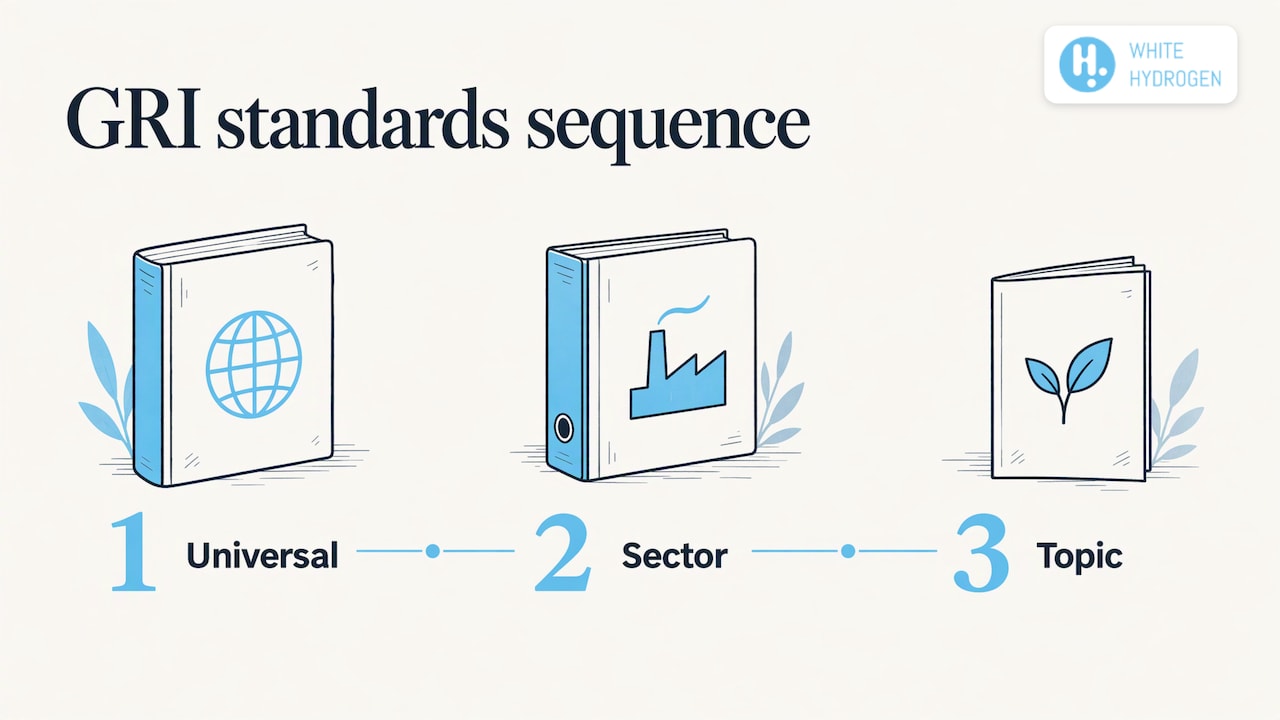
Universal Standards
These apply to every organization. According to GRI 1, there are three:
| Standard | What it covers |
|---|---|
| GRI 1: Foundation | The reporting principles and the requirements for claiming “in accordance” |
| GRI 2: General Disclosures | Who the organization is, how it is governed, its strategy, policies and stakeholder engagement |
| GRI 3: Material Topics | How to determine material topics, and how to report on each one |
GRI’s December 2022 FAQ on the Universal Standards confirms they apply to all organizations, whatever the size or sector. The revised versions took effect for reporting on January 1, 2023.
Sector Standards
Sector Standards describe the impacts that are likely in a given industry. They help you start your assessment with the topics that other organizations in your field usually have to address. They guide the assessment but do not replace it: you still have to assess your own organization. If you decide a listed sector topic is not material to you, you explain why in your report.
For energy organizations, this step is where projects are shaped. A developer weighing waste handling, land use, emissions and community effects early benefits from planning those impacts before construction, and resources on energy project development planning can help frame that thinking alongside the sector guidance.
GRI keeps adding sector coverage. Its Standards development page says the Banking, Capital Markets and Insurance Sector Standards have been approved and are planned for launch in 2027, and that projects for textiles and apparel and for food and beverages are under way.
Topic Standards
Topic Standards hold the actual disclosures. Each covers one subject, such as emissions, energy, water, biodiversity, employment or local communities. Once you know your material topics, you use the matching Topic Standards to see exactly which data points to report. You report on the topics you identified, not on every Topic Standard in the library.
The reporting principles behind every GRI report
GRI 1 sets out principles that describe the quality of what you publish. According to the official text, there are eight: accuracy, balance, clarity, comparability, completeness, sustainability context, timeliness and verifiability.
In practice, two of them decide whether a report is trusted:
- Accuracy means information is correct and detailed enough for readers to judge your impacts.
- Verifiability means the information can be checked. Records, measurement methods and data trails need to exist so that someone else could confirm a figure.
Verifiability is the principle that matters most for production data in clean energy. A claim about waste converted or emissions avoided is only as strong as the measurement behind it.
What “in accordance with the GRI Standards” requires
Organizations sometimes say they report “using” GRI. There are two different claims, and they should not be confused. Using GRI as a reference for some disclosures is one thing. Claiming to report “in accordance” is a formal claim with conditions.
Per GRI 1, an organization must meet all nine requirements to make the claim. Together they form the reporting steps:
- Apply the reporting principles. Use the eight principles above in preparing the report.
- Report the GRI 2 disclosures. These are the general disclosures about the organization.
- Determine material topics. Identify the topics that represent your most significant impacts.
- Report the GRI 3 disclosures. Explain your list of material topics and how you manage each.
- Use the relevant Topic Standards. Report the disclosures that apply to each material topic.
- Explain permitted omissions. If you cannot report a required item, the Standards allow limited omissions, and you state the reason.
- Publish a GRI content index. This is a table that tells readers where each disclosure can be found.
- Publish a statement of use. It says which version of the Standards you used and how.
- Notify GRI. You tell GRI that you have reported with the Standards.
There is one route only. GRI’s December 2022 FAQ explains that the 2021 update removed the earlier Core and Comprehensive options, so all nine conditions apply to everyone claiming “in accordance.” If an older guide mentions choosing between those two levels, it describes the previous version.
How to identify material topics
Materiality is the part of GRI reporting that most often confuses newcomers. In GRI’s definition, a material topic is one that represents your most significant impacts on the economy, environment and people. It is not the same as what is financially material to you, although the two often overlap.
The process described in GRI 1 runs like this:
- Understand your context. Map your activities, business relationships and the places where you operate.
- Identify actual and potential impacts. Include negative and positive ones, short and long term. Talk to relevant stakeholders and experts.
- Assess significance. Judge which impacts are most significant, considering scale, scope and how hard they would be to put right if negative.
- Prioritize. Rank the impacts to decide which topics to report on.
- Check the Sector Standards. Review the ones that apply to you, and explain any sector topic you judge not to be material.
- Match to Topic Standards. For each material topic, use the corresponding Topic Standard to find the disclosures to report.
A worked example makes this concrete. Imagine a facility that converts organic waste into hydrogen. Its likely material topics could include greenhouse gas emissions, energy use, waste, water and effects on the surrounding community. It would review the relevant Sector Standard, then use the emissions and energy Topic Standards to find the data points to publish. The facility would keep the measurement records that back each figure, because verifiability applies to every number in the report.
What is changing: biodiversity, mining, climate and energy
GRI revises its Standards on a rolling basis, and the Standards overview lists what has changed recently:
- The revised Biodiversity Standard (GRI 101) and the Mining Sector Standard (GRI 14) became effective for reporting in January 2026.
- The revised Climate Change and Energy Standards (GRI 102 and GRI 103) were published in June 2025 and take effect for reporting from January 2027.
The second item matters most to energy producers. GRI 102 and GRI 103 will shape how organizations disclose their emissions, climate transition and energy use. If you are planning your first report, building your data collection around these revised Standards now saves rework later.
GRI also lists work in progress on labor-related Topic Standards, economic-impact standards and pollution-related standards, according to its development page. Check that page and the Standards overview for the current schedule before you finalize a reporting plan.
Where to publish and how readers use the report
GRI does not require a particular format. Per GRI 1, the information can sit in a standalone sustainability report, on a website or inside an annual report. What ties it together is the content index, which points to each location.
Different readers take different things from it:
- Stakeholders such as neighbors, employees and customers can understand how they are or may be affected.
- Investors can assess how an organization manages impacts, integrates them into strategy, and what financial risks and opportunities follow, along with long-term success. These points come from the same GRI document.
- Management gains a structured view of impacts, which GRI Explained says helps with understanding impacts, responding to stakeholder expectations, spotting risks and opportunities and making strategic decisions.
Where verified production data fits
GRI tells you what to disclose and what quality the information must have. It does not collect the data for you. For a waste-to-hydrogen facility or any renewable plant, the hard part is getting production and impact figures that readers can trust.
That is the problem our platform addresses. The WH2C platform is an open network where clean energy producers and facilities can connect, measure and verify their impact in converting waste into green hydrogen and other sustainable energy sources. It uses blockchain-based production tracking, so results are transparent and quantifiable. Records of this kind can support the accuracy and verifiability principles that sit at the center of GRI reporting.
The platform also includes a blockchain-based crowdfunding solution for green energy plant projects, which gives local projects a way to access funding while showing their environmental impact in measurable terms. Facilities and project developers can learn more on the White Hydrogen website.
Getting started: a practical sequence
For an organization preparing its first GRI report, a sensible order is:
- Read the Universal Standards. GRI 1, 2 and 3 are the backbone, and GRI Explained gives a gentler introduction.
- Assign ownership. Name who collects data, who approves the report and who signs off on the claims.
- Map impacts and talk to stakeholders. Document the process, because GRI 3 asks you to explain it.
- Choose your Sector and Topic Standards. Build the list from your material topics.
- Set up measurement early. Data you can verify is far easier to gather as you operate than to reconstruct afterward.
- Draft the content index and statement of use. Then notify GRI.
For investors and advocates reading someone else’s report, the content index is the place to start. It shows which disclosures were made, where to find them, and which omissions the organization explained.
FAQ
What is the difference between GRI standards and GRI reporting?
The GRI Standards are the rulebook: a set of Universal, Sector and Topic Standards. GRI reporting is the process of using them, which means determining material topics and publicly disclosing information about your impacts. The result can be a standalone report, a website section or part of an annual report.
Do I have to use all of the GRI Standards?
No. Every reporting organization uses the three Universal Standards. Beyond that, you use the Sector Standards that apply to your industry and only the Topic Standards that match your material topics. Where a required disclosure cannot be reported, GRI permits limited omissions with an explanation.
What changed with the 2021 update?
The revised Universal Standards took effect for reporting on January 1, 2023. GRI’s FAQ explains that the update removed the Core and Comprehensive options, so there is one route to an “in accordance” claim, which requires meeting all nine conditions in GRI 1.
When do the new climate and energy Standards apply?
GRI published the revised Climate Change (GRI 102) and Energy (GRI 103) Standards in June 2025. They take effect for reporting from January 2027. Energy producers planning data collection now can align their systems with them.
Sources
More articles

Carbon Negative Meaning: What It Is and How to Verify It
Carbon negative means removing more CO₂ than you emit over a stated period. Learn how it differs from net zero and how to check a claim before you trust it.

Waste to Hydrogen: How It Works, What It Costs, and Where It Fits
How waste becomes hydrogen: feedstocks, thermochemical and biological routes, lifecycle emissions, costs and what producers and project backers should weigh.

Renewable Energy Integration: How Grids Absorb Solar and Wind
Renewable energy integration explained: what it means, why variable solar and wind strain grids, what it costs, and where waste-to-hydrogen producers fit in.