Renewable Energy Integration: How Grids Absorb Solar and Wind
Renewable energy integration is the work of connecting wind, solar and other clean sources to the power system so that supply and demand still match every second, at a cost people can bear. It is a system problem, not a panel or turbine problem, and the producers who handle it best are the ones who can show, with data, what their facilities deliver and when. That is the idea behind the White Hydrogen Coalition: an open platform where clean energy producers, including those turning waste into green hydrogen, connect, measure and verify their impact using blockchain-based production tracking.
This guide explains the topic for producers, local organizations, activists and investors who need the mechanics without the engineering jargon.
TL;DR
- Integration means making variable sources, mainly wind and solar, deliver reliably to a grid designed around steady power plants.
- Problems grow with share: early on they are minor, and at high shares flexibility, storage and market design decide the outcome.
- Costs depend more on how the whole system is planned than on the renewables themselves; coordinated planning sharply cuts the added cost in the IEA’s modeling.
- Storage, including conversion of electricity to hydrogen, is one of the main tools for balancing short and long swings.
- Verified, measurable production data helps producers and local projects prove their contribution; our platform is built for that.
Table of Contents
- What renewable energy integration actually means
- Why the grid needs to be reworked, not just extended
- The main challenges, in plain terms
- Integration gets harder as the share grows
- What it costs, and what drives the cost
- The toolbox: flexibility in four forms
- What is at stake if integration lags
- How each reader can act
- Where White Hydrogen fits
- FAQ
- Sources
What renewable energy integration actually means
The U.S. National Renewable Energy Laboratory (NREL) describes grid integration as developing efficient ways to deliver variable renewable energy, mainly wind and solar, to the grid. Good methods keep costs down while maintaining or improving the stability and reliability of the system.
Two terms help here:
- Variable renewable energy (VRE): wind and solar output that rises and falls with weather and time of day.
- Dispatchable power: generation an operator can turn up or down on command, such as gas, hydro or a battery.
NREL separates two kinds of study. A grid impact or connection study asks whether one wind or solar plant can be technically interconnected. An integration study looks at the whole system: what happens technically and economically when many VRE sources reach a high share together. If you are a single facility, you face the first. If you are a regional planner, a utility or an investor in a portfolio, the second shapes your outlook.
Why the grid needs to be reworked, not just extended
A grid has to keep voltage and frequency inside narrow bands, on timescales of a second or less. The Congressional Research Service notes that variable renewables require changes in power system design and operation to prevent equipment damage and outages. Since 2016, U.S. federal rules have also required wind and solar inverters to help meet some voltage and frequency requirements. Other generation or storage must ramp up fast when solar output falls, for example at sunset.
That sunset problem has a name. Resources for the Future explains that as solar grows, the net-load curve (demand minus solar output) develops a deeper “duck” belly and a steeper evening ramp, and that pairing solar with storage can help.
The main challenges, in plain terms
A 2019 ETH Zurich review sorted the symptoms of high VRE shares into four categories: power quality, flow, stability and balance. Translated:
| Category | What it looks like | Why it happens |
|---|---|---|
| Power quality | Harmonic distortion, voltage excursions | Inverter-based generation behaves differently from spinning turbines |
| Flow | Missing grid capacity, loop flows, curtailment | Good wind and sun sites are often far from demand |
| Stability | Reduced inertia and short-circuit power | Fewer large synchronous machines on the system |
| Balance | Supply and demand mismatches | Output follows weather, not demand |
Curtailment means an operator tells a plant to produce less because the grid cannot take its power. Inertia is the stored rotational energy in big turbines that slows frequency changes.
The connection queue is a visible symptom. Berkeley Lab found that over 2,000 gigawatts of generation and storage were seeking grid connection in U.S. queues at the end of 2022, over 95% of it zero-carbon. Many queued projects are never built, but the number shows how much waiting capacity depends on grid readiness.
There is also a deeper tension. An IEA paper by Mike Garwood describes a flexibility paradox: variable renewables grew thanks to the flexibility of older dispatchable plants, yet those plants are being retired just as flexibility needs rise.
Integration gets harder as the share grows
The IEA describes six phases of integration. In the first, solar and wind have no or only minor effects on operations. Later phases bring a need for flexibility investment, then structural surpluses, and finally seasonal and year-to-year imbalances that call for sector coupling, meaning linking electricity with heat, transport and fuels.
The practical lesson is that there is no one-size-fits-all plan. A region at a 5% share needs different measures from one at 50%. Short-term balancing comes first, then ultra-short stability, and only at very high shares do long-duration gaps dominate.
What it costs, and what drives the cost
People often ask how much integration costs. The honest answer is that it depends on how flexible the rest of the system already is.
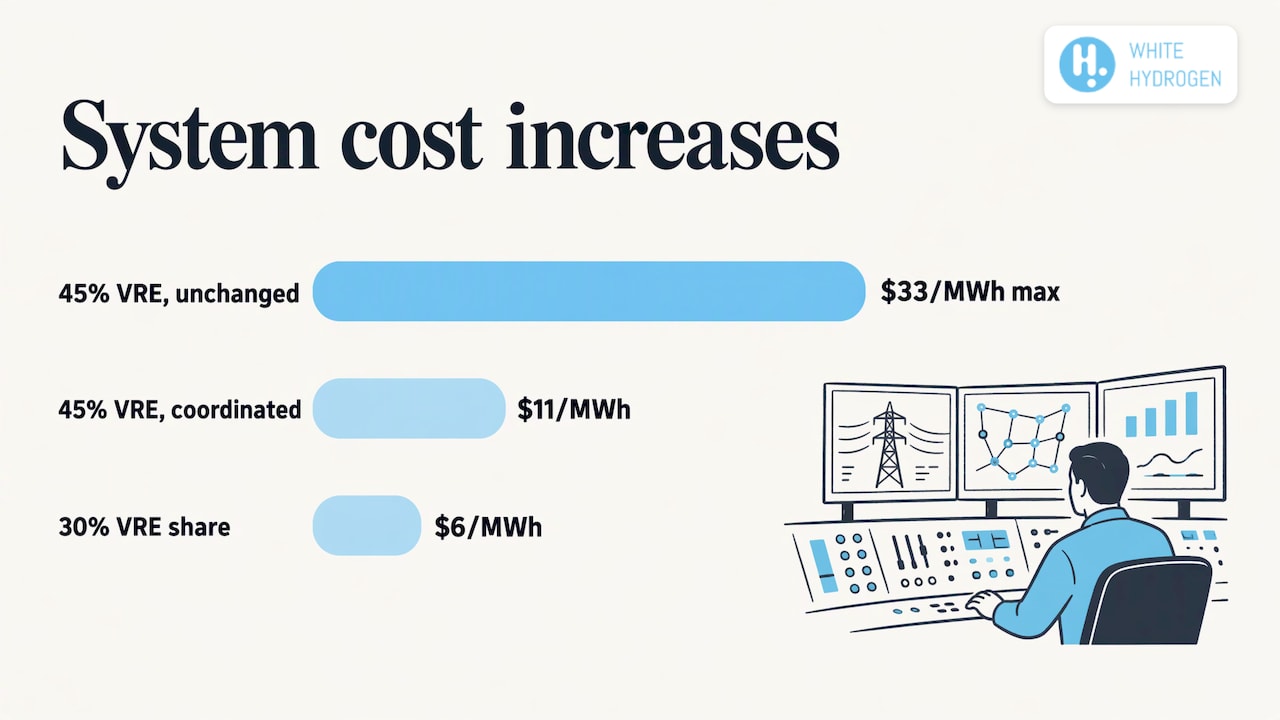
The IEA’s “Power of Transformation” modeling gives a clear example. Adding 45% VRE to a test system overnight, without changing anything else, raised total system costs by up to USD 33 per MWh, about 40%. A coordinated transformation, with a re-optimized plant mix, more flexible plants and better grid strategy, cut that increase to USD 11 per MWh. At a 30% share the increase was USD 6 per MWh. In the long run, the report says high shares may come at little or no extra cost as renewable costs fall.
IRENA lists the cost components that any analysis should include: grid costs, capacity costs and balancing costs. It adds that these should not all be charged to renewables when the system itself lacks flexibility.
A few reference points from the IEA’s 2011 study of eight power areas:
- Hardware-only balancing potential ranged from 19% in Japan to 63% in Denmark, with the U.S. Western Interconnection at 45%.
- Wind balancing costs were USD 1 to 7 per MWh at a 20% wind share.
Those are 2011 figures for specific systems, useful as a sense of scale rather than a forecast for your site.
For comparing sources, note that the standard levelized cost of energy (LCOE) leaves out system-wide effects. The IEA’s 2024 paper says firming, networks, storage and stability costs change the comparison, so a cheap-looking kilowatt-hour from one source is not directly comparable with one from another.
The toolbox: flexibility in four forms
The IEA groups flexibility into four asset categories: power plants, network interconnections, energy storage and distributed energy resources (small generators, batteries and controllable loads close to where power is used). Policy and market rules should let batteries and distributed resources be paid for the flexibility they provide.
Storage and hydrogen
IRENA’s general guidance is 1 to 2 MW of storage for every 10 MW of renewable capacity added, while noting that national conditions set the real need. Its earlier technology brief explains that storage can handle short variability of up to several hours, and longer variability through pumped hydro, thermal storage or conversion of electricity into hydrogen or gas.
That hydrogen route is where our field sits. Hydrogen made from waste streams can turn surplus or hard-to-use energy into a storable fuel. For homes and small sites, the same logic starts smaller, with battery options for solar systems that smooth daily swings.
Markets and planning
Hardware is only half of it. The IEA’s 2011 analysis concluded the balancing challenge is far from insurmountable, but only with early investment in grid infrastructure and market mechanisms that price flexibility. IRENA’s 2024 outlook adds that marginal-pricing markets fail to signal investment in flexibility, and that policy uncertainty undermines investor confidence.
What is at stake if integration lags
The IEA warns that delaying integration measures could put up to 15% of solar and wind generation in 2030 at risk and cut the power sector’s CO2 reduction by up to 20%. Successful integration, by contrast, maximizes secure, affordable energy and reduces fossil fuel dependence through dispatchable generation, grid upgrades, storage and demand response.
For a producer, that means a plant that can be connected, measured and trusted. For a community, it means local projects that deliver the emissions benefits they promise.
How each reader can act
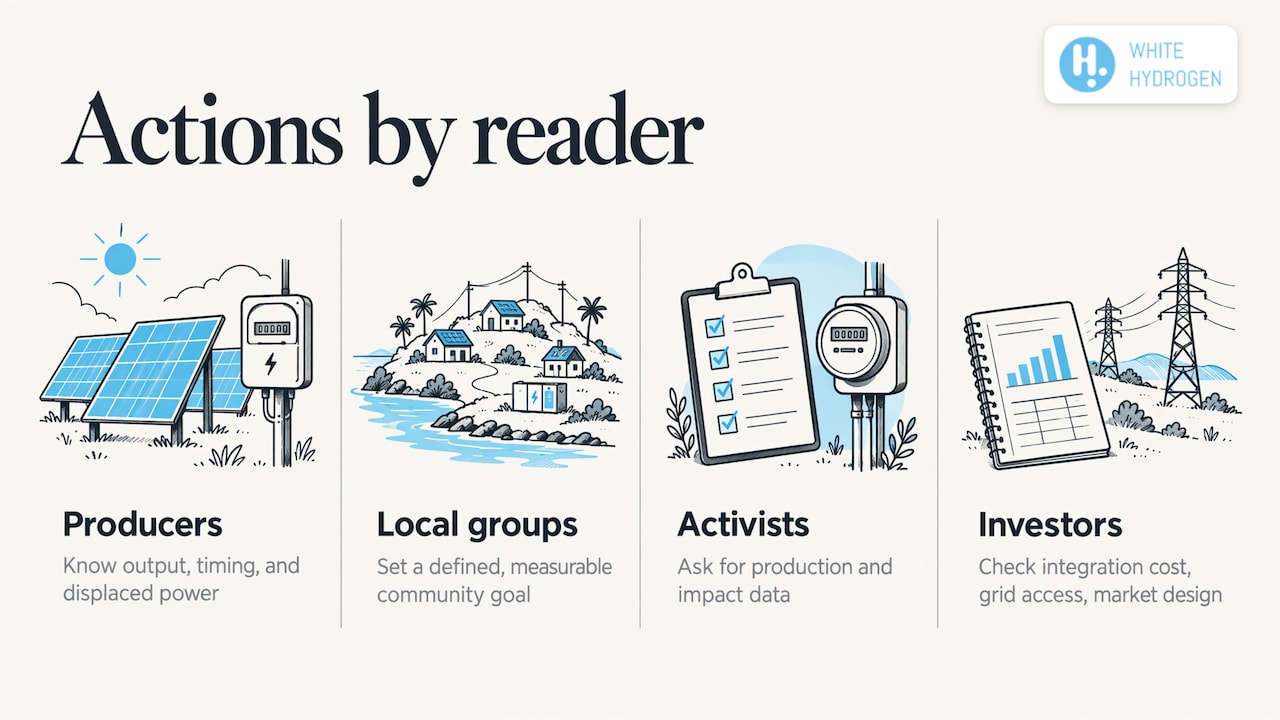
Clean energy producers and facility operators. Start with the connection process and the data. Grid operators and funders respond to metered, verifiable output. Know your facility’s profile: when it produces, how much, and what it displaces.
Local organizations. Integration is local before it is national. Mini-grids and island systems are, in IRENA’s words, among the immediate applications where integration technologies are economically attractive, with the Jeju Island smart grid demonstration in South Korea as an example. Community-scale projects can start with a defined, measurable goal.
Activists reducing carbon footprints. Ask what is measured. A claimed reduction means little without production and impact data behind it.
Investors in green technology. Read the system, not just the asset. Integration cost, grid access and market design shape project outcomes as much as technology does. This article is general information, not investment, legal or tax advice.
Where White Hydrogen fits
We built the White Hydrogen Coalition platform for producers who convert waste into green hydrogen and other sustainable energy. Our approach combines verified production tracking with blockchain transparency, so each connected facility can measure its impact and show quantifiable results. The platform is open to multiple renewable technologies rather than a single one, and it includes a blockchain-based crowdfunding tool designed to help local green energy projects reach funding while documenting their environmental impact.
If you operate a facility or develop a project and want it to join a network built around verified, measurable impact, you can learn more about the WH2C platform on our site.
FAQ
What is the meaning of renewable energy integration?
It is the process of incorporating renewable sources, mainly variable wind and solar, into the power system so that the grid stays stable, reliable and affordable. It covers physical connection, system operation, planning and market rules.
What are the main challenges of integrating renewables into the grid?
Researchers group them into power quality, flow, stability and balance. In practice that means voltage and frequency control, limited transmission capacity, curtailment, lower inertia and matching variable output to demand.
How much does integration cost?
It varies with how flexible the system is. In the IEA’s modeling of a 45% VRE share, uncoordinated additions raised system costs by up to USD 33 per MWh, while coordinated planning cut the increase to USD 11 per MWh. Your own cost depends on your grid, region and rules.
Does storage solve integration?
Storage is a major tool, especially for daily swings and, through options such as hydrogen, for longer gaps. It works best alongside grid upgrades, interconnections, flexible demand and market rules that pay for flexibility.
Sources
- NREL: Integrating Variable Renewable Energy Into the Grid, Key Issues
- NREL: Variable Renewable Energy Grid Integration Studies
- Congressional Research Service: Variable Renewable Energy, An Introduction
- Resources for the Future: Renewables 101, Integrating Renewable Energy Resources
- ETH Zurich: Challenges and solution technologies for the integration of variable renewables
- Berkeley Lab: Queued Up, interconnection queues at the end of 2022
- IEA: Maintaining a Stable Electricity Grid in the Energy Transition
- IEA: Introduction to System Integration of Renewables
- IEA: The Power of Transformation
- IEA: Harnessing Variable Renewables
- IEA: Integrating Solar and Wind
- IEA: Integrating Solar and Wind, executive summary
- IRENA: World Energy Transitions Outlook 2024
- IRENA: Renewable Energy Integration in Power Grids
More articles

California SB 253 Explained: Who Reports, What and When
SB 253 explained: who must report, the $1 billion threshold, Scope 1, 2 and 3 timing, assurance, penalties and what the Ninth Circuit ruling changed.

Carbon Management Software: What It Does and How to Choose
Carbon management software explained for clean energy producers, local groups and investors: what it tracks, how to judge it, and why verified data matters most.
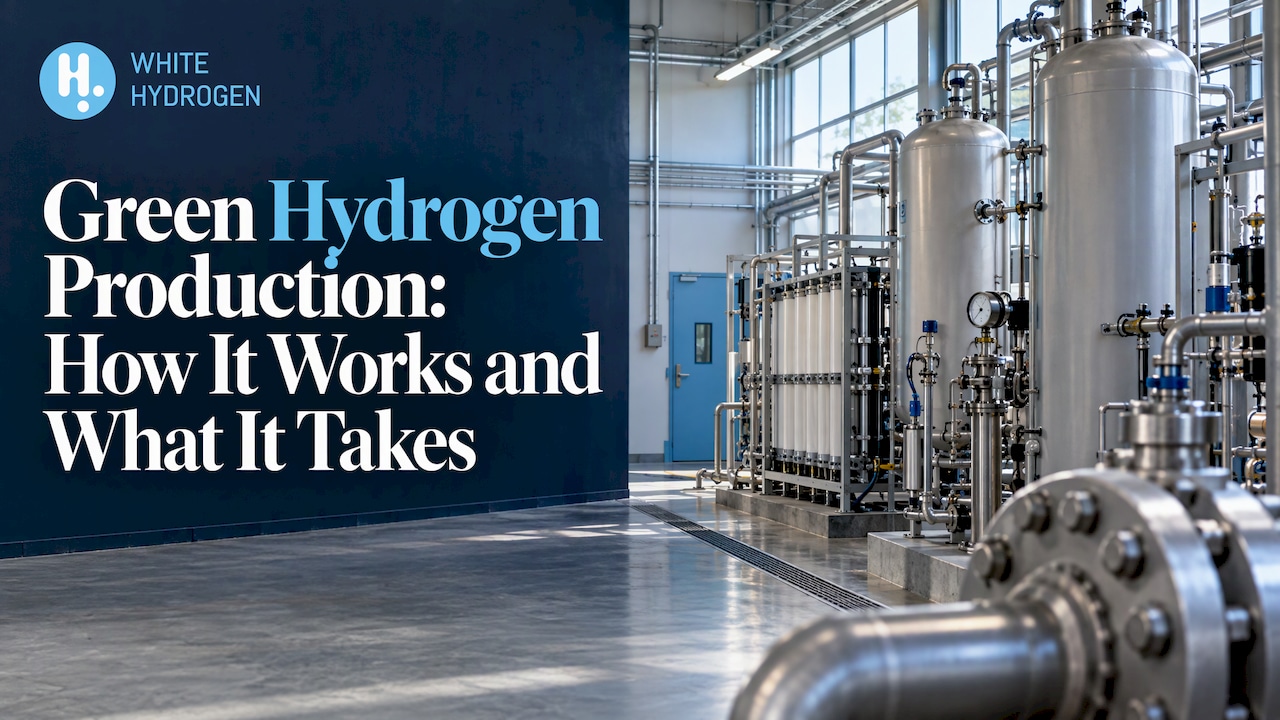
Green Hydrogen Production: How It Works and What It Takes
How green hydrogen is produced from renewable power and water: electrolyzer types, efficiency, costs, water needs and what makes a project work at scale.