Green Hydrogen Production: How It Works and What It Takes
Green hydrogen is made by using renewable electricity to split water into hydrogen and oxygen, a process called electrolysis. The technology is proven. What decides whether a project works is how many hours the plant runs, what its power costs, and whether its results can be measured and verified. That last point is why we built the White Hydrogen Coalition platform at WH2C: so producers can connect, track production and show the impact of converting waste and renewable energy into hydrogen.
TL;DR
- Green hydrogen comes mainly from electrolysis powered by wind, solar or hydropower. Alkaline, PEM and solid oxide electrolyzers are the three main types.
- Electrolyzers convert roughly 60% to 85% of their energy input into hydrogen, depending on type, according to a 2025 industry observatory report.
- Electricity is the largest cost, and operating hours matter as much as capital cost.
- Each kilogram needs about nine liters of water, so site choice matters in water-stressed regions.
- Verified, transparent production data helps projects prove their climate benefit and attract funding.
Table of Contents
- How green hydrogen is produced
- Green hydrogen production methods compared
- How solar, wind and hydropower feed the process
- What drives efficiency and cost
- Water and climate: the constraints that shape siting
- Where production stands at scale
- Proving the impact of production
- Connecting your facility to the WH2C platform
- FAQ
- Sources
How green hydrogen is produced
The core process is simple. An electrolyzer passes an electric current through water. The water molecules separate into hydrogen at one electrode and oxygen at the other. If the electricity comes from wind, solar or hydropower, the hydrogen is called green, because the process itself emits no carbon dioxide.
A plant has four main parts:
- Renewable power supply: a solar array, a wind farm, a hydro plant, or a mix, sometimes with batteries.
- Water treatment: electrolyzers need clean water, so raw or desalinated water is purified first.
- The electrolyzer stack: where water is split. Stacks are grouped into modules and scaled up to megawatts or gigawatts.
- Hydrogen conditioning and storage: the gas is dried, compressed or liquefied, then stored or piped to users.
The Institute of Energy Knowledge notes that electrolysis runs at 20 to 100°C and yields hydrogen that is purer than reformed hydrogen, which suits fuel cells without costly purification.
Green hydrogen production methods compared
The US Department of Energy groups hydrogen production into thermochemical, electrolytic, direct solar water splitting and biological pathways. Of these, electrolysis is the one that is commercially available today. Direct solar water splitting and microbial routes are still at research or pilot stage.
The three electrolyzer technologies
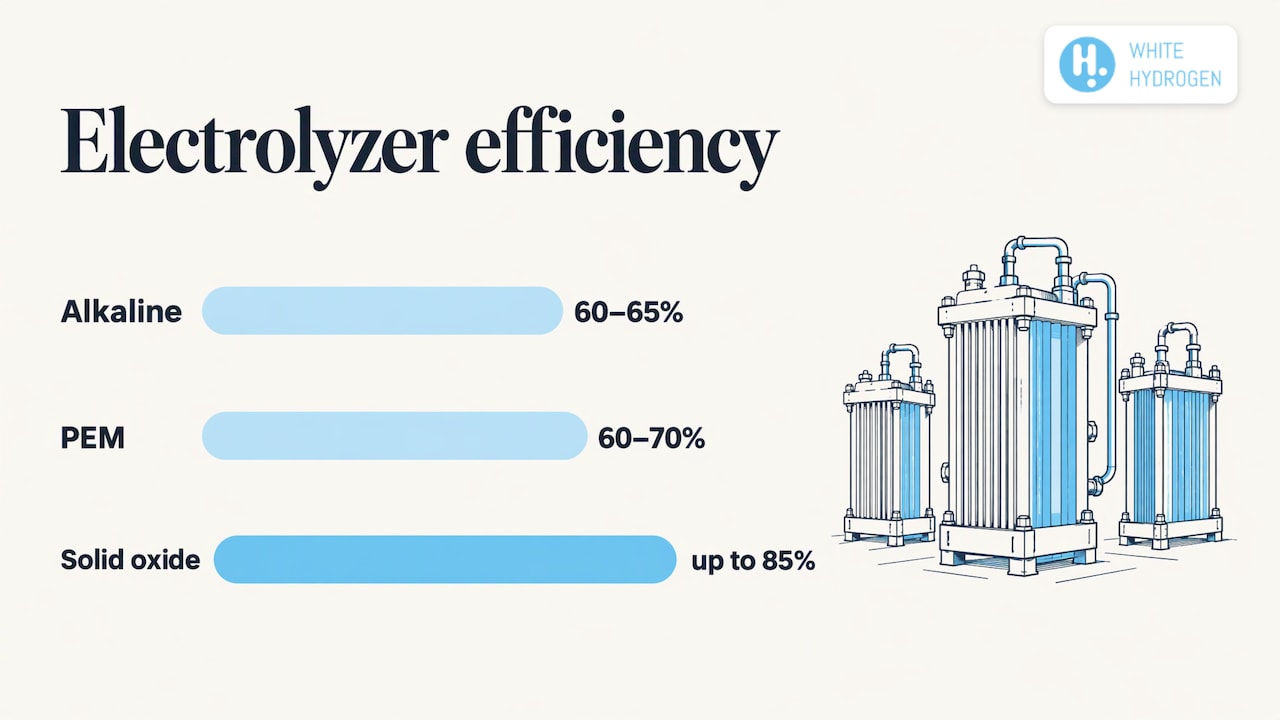
A 2024 review in Energies describes alkaline electrolysis as the most common method thanks to its low cost, PEM electrolysis as an improvement in operational efficiency, and high-temperature solid oxide electrolysis as a route that uses waste heat at 500 to 900°C to cut the electricity needed.
The Hydrogen Technology Observatory’s December 2025 report and a 2025 peer-reviewed comparison give these figures:
| Technology | Efficiency (LHV) | Capital cost (USD/kW) | Energy use (kWh/kg H2) | Lifespan (hours) |
|---|---|---|---|---|
| Alkaline | 60–65% | 800–1,200 | 50–60 | 60,000–90,000 |
| PEM | 60–70% | 1,500–2,200 | 45–55 | 40,000–60,000 |
| Solid oxide (SOEC) | up to 85% | 2,000–3,000 | 40–50 | 20,000–40,000 |
Alkaline units made roughly 75% of global electrolyzer manufacturing capacity in 2024, according to the same observatory. PEM held about 22% of 2025 capacity, and solid oxide, still pre-commercial, about 3% by the end of 2025.
The 2025 comparison concludes that alkaline remains the most cost-effective choice for large-scale production, while solid oxide’s higher efficiency is offset by high operating temperatures and capital cost. PEM units are the usual fit where output must follow variable wind or solar power.
Bio-based routes
Hydrogen can also be called renewable when it comes from biomass or waste. A 2023 University of Vaasa review covers biomethane reforming, biomass pyrolysis and gasification, and biogas reforming through anaerobic digestion. This is the territory where waste-to-hydrogen projects sit, and it matters to local facilities that already handle organic waste streams.
How solar, wind and hydropower feed the process
Electrolyzers need power, and renewable sources deliver it differently.
- Wind: often gives high capacity factors and steady output. A 2024 study by Terlouw and colleagues found wind-powered electrolysis had lifecycle emissions of 1.1 to 1.8 kg CO2-equivalent per kg of hydrogen.
- Solar PV: cheap and modular, but available only in daylight hours. The same study found ground-mounted PV at 2.6 to 4.5 kg CO2-eq/kg, with emissions falling as energy systems decarbonize.
- Hybrid wind and solar: smooths output. IRENA’s cost report notes hybrid plants at the best sites can exceed 5,000 full-load hours per year.
The lesson for project developers: where the electricity comes from sets both the cost and the carbon footprint of every kilogram, which is why verified production records matter.
What drives efficiency and cost
Operating hours
A full-load hour is an hour the electrolyzer runs at rated power. IRENA’s policy guide states that below a 10% capacity factor (under 876 hours a year), hydrogen costs reach USD 5 to 6 per kg or more even with free electricity. The cost report adds that 3,000 to 4,000 operating hours a year may be enough to capture the largest reduction in the capital cost contribution.
Electricity price
Because of conversion losses, each USD 20/MWh of power cost adds roughly USD 31/MWh to the final hydrogen cost, a little over USD 1 per kg. Renewable electricity is the largest single cost component. Power prices vary by hour and by tariff structure, so understanding when and how electricity is billed is part of the economics; this explainer on peak electricity rates covers how time-based pricing works.
Electrolyzer cost and scale
IRENA argues that scaling up electrolyzers, with better catalysts, standardized designs and mass production, is what brings costs down. A 2024 analysis by Terlouw and colleagues puts the average specific production cost at EUR 1.7 to 2.2 per kg across technologies. Cost studies are dated and sites differ widely, so treat any figure as a snapshot of the study’s own period and location.
Water and climate: the constraints that shape siting
Electrolysis needs about nine liters of water per kilogram of green hydrogen, according to the Institute of Energy Knowledge. UNDP’s 2025 report, citing IRENA, finds that green hydrogen from PEM and alkaline electrolysis has the lowest water withdrawal and consumption rates of all hydrogen pathways. It also notes that sunny and windy regions are often water-stressed, so water assessments belong in early planning. Where desalination is used, about 48 kg of brine results per kg of hydrogen, and it needs careful handling.
On climate, Terlouw and colleagues found renewable electrolytic hydrogen produces 50 to 90% fewer greenhouse gas emissions than fossil-based hydrogen without carbon capture.
Where production stands at scale
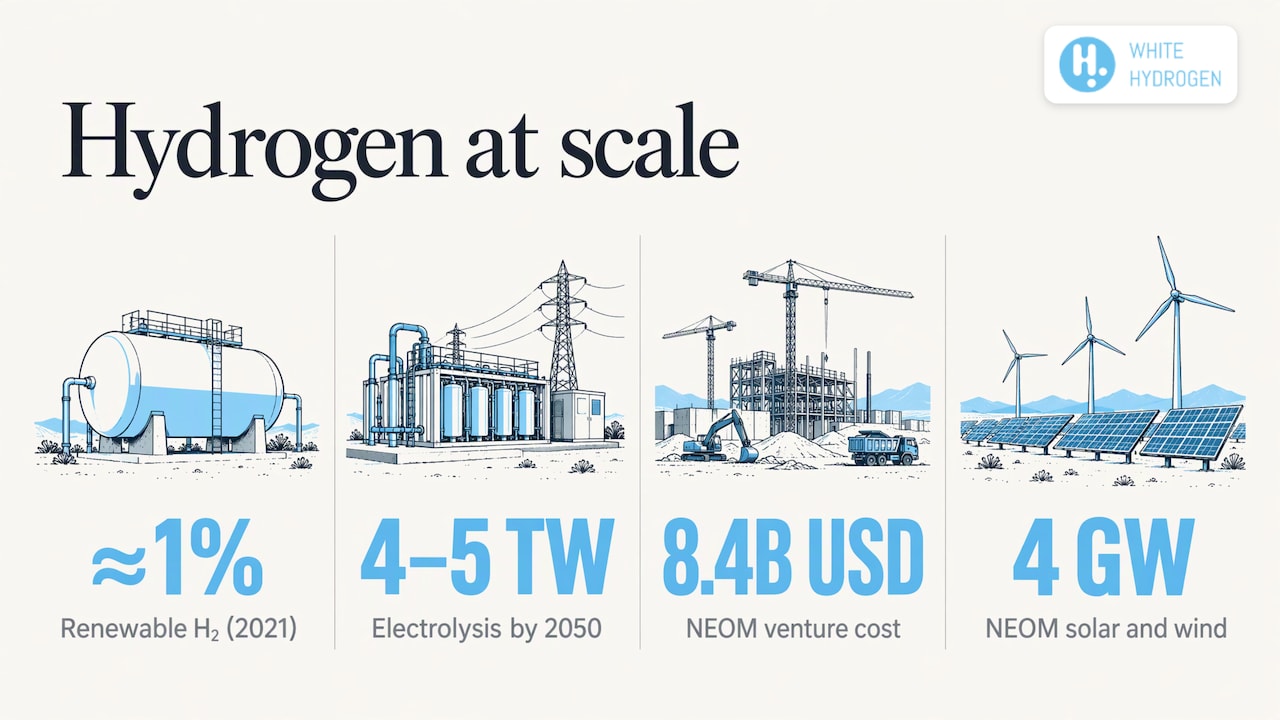
IRENA reports that only about 1% of global hydrogen was produced with renewable energy at the end of 2021, against roughly 75 million tonnes a year of pure hydrogen overall. Reaching a 1.5°C pathway would need 4 to 5 TW of electrolysis capacity by 2050.
Large projects show the direction. NEOM in Saudi Arabia is described as a USD 8.4 billion venture aiming at up to 219,000 tonnes of hydrogen a year, powered by 4 GW of on-site solar and wind. In Western Australia, the Murchison project was selected under the Hydrogen Headstart scheme, which shows how government support shapes project economics.
Most local organizations will never build at that scale. For them, smaller plants tied to local waste, local power and local funding are the realistic route.
Proving the impact of production
A kilogram of hydrogen is only “green” if the electricity behind it was. Producers, funders and communities all benefit from records that show what a facility produced and what carbon it avoided. Our approach at White Hydrogen combines blockchain technology with verified production processes, so results are transparent and quantifiable.
Connecting your facility to the WH2C platform
The WH2C platform is an open platform where green energy producers and facilities connect, measure their impact and work toward lower carbon footprints, whatever renewable technology they use. It includes blockchain-based production tracking and a crowdfunding tool that helps local green energy projects reach funding while documenting quantifiable environmental impact. If you operate a facility or develop a project that turns waste into green hydrogen or other sustainable energy, start at whiteh2coin.com.
FAQ
What is the most common way to make green hydrogen?
Water electrolysis powered by renewable electricity. Alkaline electrolyzers are the most widely manufactured type, while PEM and solid oxide units serve other needs such as flexible operation or higher efficiency.
How much water does green hydrogen need?
About nine liters per kilogram of hydrogen, according to the Institute of Energy Knowledge. Plants in dry regions often add desalination, which is why site water assessments matter.
Can hydrogen be renewable without electrolysis?
Yes. Biomass gasification, biomethane reforming and biogas-based routes can produce renewable hydrogen from organic waste, as reviewed by the University of Vaasa.
What matters most for the cost of green hydrogen?
The price of renewable electricity and the number of hours the electrolyzer runs each year. Electrolyzer capital cost and scale come next.
Sources
- Hydrogen Production Processes, US Department of Energy
- Green Hydrogen: Production and Storage Methods, Energies (MDPI) 2024
- Comprehensive Analysis of Green Hydrogen Production, 2025
- Renewable hydrogen production via electrolysis, Hydrogen Technology Observatory, December 2025
- Sources and technologies for green hydrogen production, University of Vaasa, 2023
- Green hydrogen cost reduction, IRENA, 2020
- Green hydrogen: A guide to policy making, IRENA, 2020
- Hydrogen, IRENA
- Future hydrogen economies imply environmental trade-offs, 2024
- Navigating the Currents of Green Hydrogen, UNDP, 2025
- Where and how is hydrogen sourced?, Energy Institute
- A hydrogen superpower, Inside Saudi
- Argus Hydrogen and Future Fuels, March 2025
More articles
Sustainability Data Platform: What It Does and How to Choose
A sustainability data platform collects, verifies and reports environmental data. See what it tracks, how it validates output and how to pick one for your site.
Renewable Energy Asset Management: A Practical Guide
What renewable energy asset management covers, which KPIs matter, how data platforms help, and why verified production data is the base of every decision.
Industrial Decarbonization: Where Emissions Come From and How to Cut Them
Industrial decarbonization explained: where industrial carbon emissions come from, the five main levers, what they cost, and how producers can verify results.