Industrial Decarbonization: Where Emissions Come From and How to Cut Them
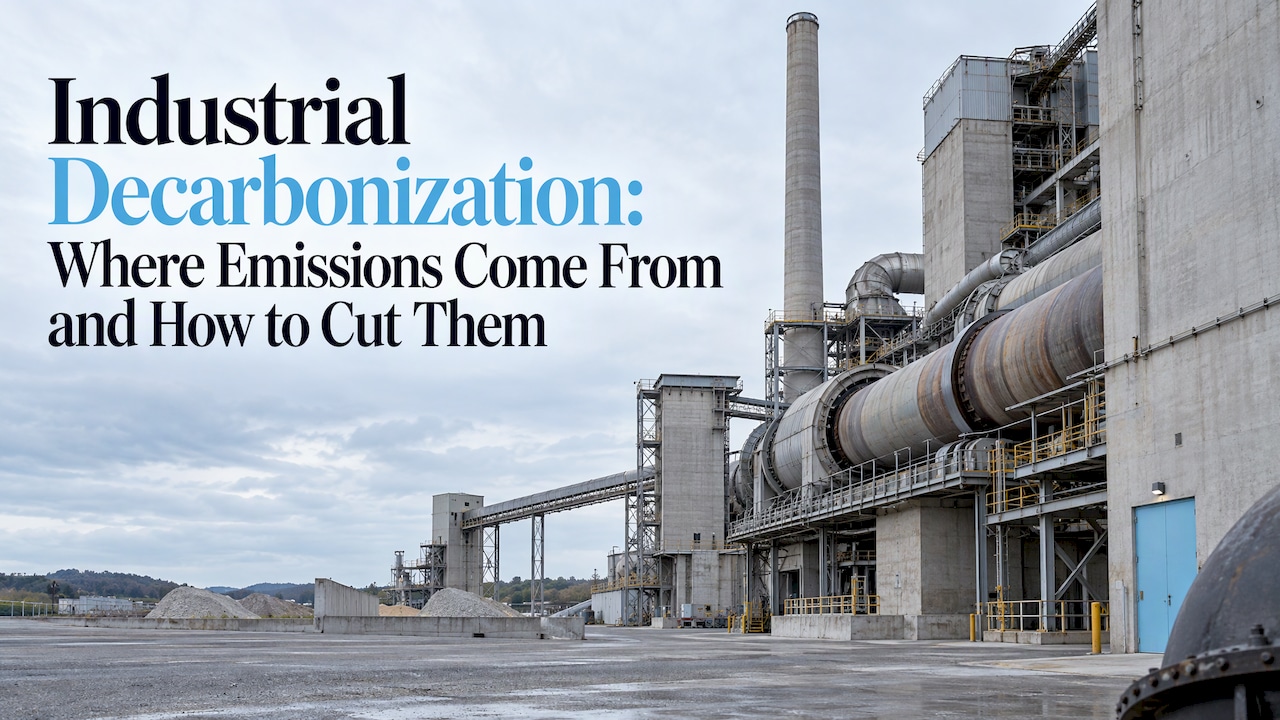
Industrial decarbonization means cutting the greenhouse gases that factories, refineries and processing plants release, through efficiency, cleaner fuels, electrification, process change and carbon capture. The hard part is proof: projects only attract capital and trust when their reductions are measured and verified. That is why we built the White Hydrogen Coalition platform, which connects waste-to-green-hydrogen and other clean energy facilities, tracks production on a blockchain and lets them measure their impact.
TL;DR
- Industry caused 30% of total US greenhouse gas emissions in 2022 when direct and indirect (purchased electricity) emissions are counted, according to the US EPA.
- Heavy-industry emissions must fall at least 20% by 2030 and 90% by mid-century to stay on net-zero pathways, says UNIDO.
- No single technology does the job: efficiency, electrification, clean fuels and feedstocks, material efficiency and carbon capture all play a part.
- Costs vary enormously, from savings for efficiency to hundreds of dollars per tonne for hydrogen, so verified results matter for funding.
Table of Contents
- What industrial decarbonization means
- Where industrial carbon emissions come from
- How to measure an industrial carbon footprint
- The main ways to cut industrial emissions
- What industrial decarbonization costs
- Barriers and what helps
- How the White Hydrogen Coalition helps
- FAQ
- Sources
What industrial decarbonization means
Decarbonization is the process of reducing carbon emissions tied to electricity, industry and transport. UNIDO’s guidebook notes that industry accounts for around a quarter of global energy-related CO2 emissions. Heavy sectors such as steel, cement and chemicals represent over 15% of total global greenhouse gas emissions and about 70% of direct industrial emissions.
So industrial decarbonization is the set of changes that lets factories keep making steel, fertilizer, cement, food and chemicals while releasing far less carbon. It is harder than decarbonizing power. Stanford’s Understand Energy hub points out that, unlike electricity, industry still lacks cost-effective, scalable technologies across the board.
Where industrial carbon emissions come from
The US EPA splits industrial emissions into two groups:
- Direct emissions: fuel burned on site, chemical reactions and leaks.
- Indirect emissions: fossil fuels burned at power plants to make the electricity a facility buys.
In 2022, direct and indirect industrial emissions together were 30% of the US total, the second-largest sector. Direct emissions alone were 23%, the third-largest after transportation and electric power. Including electricity, US industrial emissions have fallen 22% since 1990.
ENERGY STAR reports that roughly 75% of industrial greenhouse gases are CO2 from on-site fossil fuel combustion and purchased electricity, with the rest from process emissions and gases such as refrigerants and methane. On-site fossil fuel use typically contributes 60 to 70% of a sector’s total. The highest-emitting US sectors are chemicals, petroleum refining, cement, iron and steel, glass, pulp and paper, food processing and aluminum.
Why some emissions are hard to remove
The Council on Foreign Relations explains that some CO2 comes from the chemistry itself, not just fuel:
- Steelmaking releases CO2 as coke strips oxygen from iron ore.
- Cement releases CO2 when limestone is heated to form clinker.
- Ammonia made from natural gas emits CO2.
- Petrochemical feedstock processing emits methane and CO2.
Heat is the other obstacle. Electric heating is practical up to about 750°F, while steel and cement need temperatures near or above 2,000°F.
How to measure an industrial carbon footprint
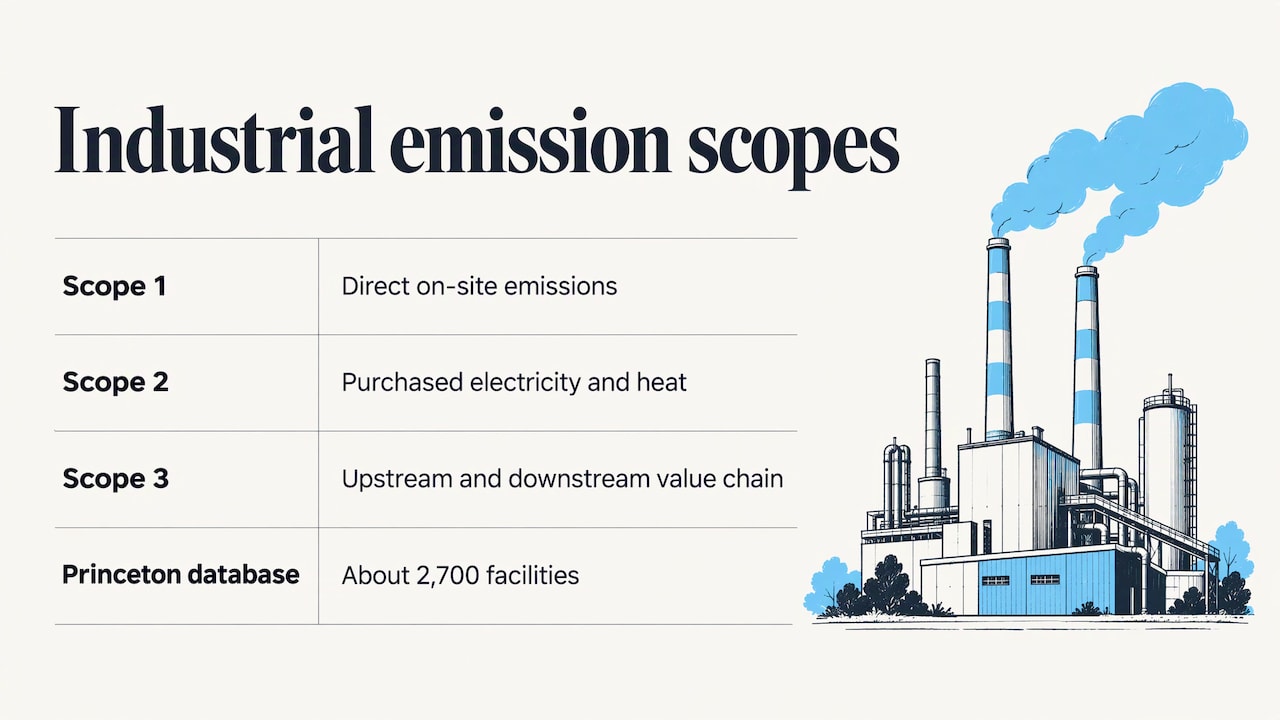
A footprint is usually counted in three scopes: scope 1 (direct emissions on site), scope 2 (purchased electricity and heat) and scope 3 (the value chain upstream and downstream). A Princeton roadmap for the chemical industry shows the approach at scale: it uses a database of about 2,700 facilities to estimate abated CO2 across scopes 1, 2 and upstream 3, along with capital needs and levelized abatement costs.
For a single plant, the principle is the same: measure a baseline, apply a change, then verify the difference. Domingues (2025) argues that standardized measurement and verification methods such as ISO 50001 and IPMVP Option B can turn energy audits from compliance exercises into bankable tools.
The main ways to cut industrial emissions
UNIDO sets five building blocks: material efficiency, energy efficiency, low-carbon energy and feedstocks, electrification and process change, and carbon capture and storage. The OECD stresses that a combination is needed, partly because 17% of industrial energy use is fossil fuel used as a feedstock rather than for heat.
| Lever | What it does | Best fit |
|---|---|---|
| Energy efficiency | Uses less fuel and power for the same output | Nearly every plant, first step |
| Electrification | Replaces combustion with renewable power, heat pumps | Low and medium temperature heat |
| Low-carbon fuels and feedstocks | Biomass, clean hydrogen, waste-derived fuels | Chemicals, steel, high-heat processes |
| Material efficiency and circularity | Recycles and reuses materials, lowers demand | Metals, plastics, construction |
| Carbon capture | Captures CO2 at the stack or process | Cement, chemicals, process emissions |
Meng et al. (2025) advise starting with approaches that are ready now, namely efficiency, recycling and electrification, while carbon capture and clean hydrogen need substantial long-term investment. The World Resources Institute adds that cement, steel and chemicals cannot be decarbonized by clean energy alone, and need new technologies and lower demand for conventionally produced materials.
Where waste-to-hydrogen fits
Hydrogen made from waste with clean energy can serve as a low-carbon fuel and feedstock, the third lever in the table. It also turns a disposal problem into an energy product, which is the circular-economy logic behind our work.
What industrial decarbonization costs
The same Meng et al. paper gives abatement cost ranges per tonne of CO2 avoided:
| Approach | Cost range (US$/tCO2) |
|---|---|
| Energy efficiency | -10 to 80 |
| Electrification | 2 to 201 |
| Biomass | 23 to 904 |
| Carbon capture | 10 to 90 |
| Hydrogen | 100 to 1,000 |
Green premiums, the extra price of a low-carbon product, are under 20% for scrap-based electric arc furnace steel. They exceed 50% for bioenergy in steel, cement kiln electrification and green hydrogen use. Costs differ widely by product and technology, so a project-specific number always beats a sector average.
A worked example
A verified Portuguese food-processing retrofit recovered waste heat from compressors. It delivered 1,260 MWh of annual fuel savings (a 7.8% cut in thermal demand), avoided 307 tonnes of CO2e and saved €54,600 a year on a €95,000 investment. That is a payback of 1.7 years, verified with a combined uncertainty of ±3.6%. The lesson: a documented, measured result is what makes a project financeable.
Barriers and what helps
An analysis of 29 industry roadmaps across 13 countries found common barriers in policy, finance and technology, and efforts that are poorly aligned. The OECD adds that many needed technologies are still at demonstration or early commercial stage, are capital intensive, and face limited finance and skills gaps.
Stanford notes that electrification faces higher operating costs and limited readiness above 500°C, though industrial heat pumps and thermal storage, which lets plants buy power in the cheapest hours, improve the economics.
For producers and local organizations, three things follow:
- Start with measures that pay back quickly and build a verified baseline.
- Make results transparent so lenders, partners and communities can trust them.
- Find funding routes that fit small, local projects.
How the White Hydrogen Coalition helps
We run an open platform where clean energy producers and facilities that turn waste into green hydrogen and other sustainable energy can connect, measure their impact and verify it. Our approach pairs verified production processes with blockchain tracking, so results are transparent and quantifiable. The platform includes a carbon footprint reduction ecosystem, our Plant Starter program, the WH2C utility token and a blockchain-based crowdfunding solution that helps local green energy projects raise funds.
If you operate a facility or develop a project, join the WH2C platform to connect your site and show the impact it delivers.
FAQ
What is industrial decarbonization in simple words?
It means reducing the greenhouse gases that industry releases when making goods. That includes cutting fuel use, switching to cleaner energy, changing processes and capturing CO2 that cannot be avoided.
What are the main industrial emissions?
They are direct emissions from on-site fuel burning, chemical reactions and leaks, plus indirect emissions from the electricity a plant buys. ENERGY STAR says about 75% of industrial greenhouse gases are CO2 from fuel and purchased power.
How much does decarbonization cost?
It depends on the technology and product. Published abatement costs run from a net saving for some efficiency measures to as much as US$1,000 per tonne of CO2 for hydrogen. A verified project-level assessment gives the reliable figure for your site.
Which industries emit the most?
In the US, the highest-emitting sectors are chemicals, petroleum refining, cement, iron and steel, glass, pulp and paper, food processing and aluminum.
Sources
- US EPA: Industry Sector Emissions
- UNIDO: NDC 3.0 Guidebook for Industrial Decarbonization
- Stanford Understand Energy: Industry Decarbonization
- ENERGY STAR: Sources of Industrial Greenhouse Emissions
- Council on Foreign Relations: How to Lower Industry-Sector Emissions
- Princeton ACEE: chemical industry roadmap
- Techforum Journal: Industrial Energy Efficiency and Thermal-Energy Recovery
- OECD: Framework for industry’s net-zero transition
- Nature Reviews Clean Technology: Technologies and gaps in deep decarbonization
- World Resources Institute: The 5 Shifts Needed to Decarbonize Industry
- Applied Sciences: Toward Climate-Neutral Heavy Industry
- OECD: Work in support of industrial decarbonisation
More articles
Renewable Energy Asset Management: A Practical Guide
What renewable energy asset management covers, which KPIs matter, how data platforms help, and why verified production data is the base of every decision.
Hydrogen Production Costs: What Drives the Price per Kilogram
What hydrogen costs per kilogram by pathway, what drives the price, how levelized cost is calculated, and where projects can cut costs, with sources.
Energy Infrastructure: What It Includes and How It's Changing
Energy infrastructure explained: generation, storage, transmission and distribution, how renewables plug in, what policy shifts mean, and where local projects fit.