California SB 253 Explained: Who Reports, What and When

SB 253, the Climate Corporate Data Accountability Act, requires large businesses that operate in California to publicly report their greenhouse gas emissions every year. As of November 2026, the first Scope 1 and 2 reports were due on November 10, 2026, and a Ninth Circuit ruling left that part of the law standing while putting the Scope 3 requirement in doubt. For clean energy producers, project developers and the organizations around them, the law matters twice: directly if you cross the revenue threshold, and indirectly because covered companies will ask their suppliers and partners for verified emissions data.
This guide is general information, not legal, tax or investment advice. If you think your company is covered, confirm it with your own counsel.
TL;DR
- SB 253 applies to U.S. business entities with total annual revenue above $1 billion that do business in California, public or private.
- First-year (2026) reports cover Scope 1 and 2 emissions only; the deadline was November 10, 2026. Scope 3 was scheduled to begin in 2027.
- On November 9, 2026, the Ninth Circuit let the Scope 1 and 2 requirements proceed but found the Scope 3 requirement likely unconstitutional, sending the severability question back to the district court.
- Independent limited assurance is required for Scope 1 and 2, with reasonable assurance from 2030; penalties are capped at $500,000 per entity per reporting year.
- Smaller producers and local projects are not covered directly, but covered buyers are likely to request emissions data down their value chains.
Table of Contents
- What SB 253 requires
- Who must report
- Where the law stands after November 2026
- What covered companies disclose
- Assurance: who checks the numbers
- Fees and penalties
- What this means for clean energy producers and local projects
- How White Hydrogen fits
- FAQ
- Sources
What SB 253 requires
The law was signed in October 2023. According to the enrolled bill text, covered entities must annually disclose their emissions for the prior fiscal year, and an independent third party must provide assurance on the report.
Three terms come up constantly:
- Scope 1 is direct emissions from sources the company owns or controls, such as boilers, furnaces and company vehicles.
- Scope 2 is indirect emissions from the electricity, steam, heating or cooling the company buys.
- Scope 3 is everything else along the value chain: purchased goods, business travel, waste, employee commuting, and the use of sold products.
The California Air Resources Board (CARB), the state agency that implements the law, describes the schedule in its October 12, 2026 bulletin: first-year disclosures in 2026 address Scope 1 and Scope 2, and Scope 3 disclosures were set to begin in 2027.
Who must report
The bill text covers partnerships, corporations, limited liability companies and other business entities formed under California, another state’s, D.C. or federal law, with total annual revenues above $1,000,000,000 that do business in California. Revenue is judged on the prior fiscal year.
Two details trip people up:
- Private companies count. Coverage turns on revenue and California nexus, not on whether the company is publicly traded, according to Regbase’s tracker.
- “Doing business in California” is broad. Grant Thornton’s analysis of the Initial Regulation explains that it means being organized or commercially domiciled in California, or having California sales above the lesser of $500,000 or 25 percent of total sales. The same analysis notes that revenue is measured as the lesser of the two previous fiscal years.
SB 261, a companion law on climate-related financial risk reports, uses a lower $500 million threshold, per CARB’s Updated Informative Digest. The Ninth Circuit ruling discussed below blocks SB 261 for now, so this article stays with SB 253.
Where the law stands after November 2026
The past two years have been unusually busy, so here is the sequence in plain terms.
The regulation is final
According to Regbase’s lifecycle tracker, the Initial Regulation was proposed in December 2025, adopted by CARB’s Board on February 26, 2026, withdrawn briefly for limited clarifying changes, resubmitted in September and approved by the Office of Administrative Law. CARB’s bulletin confirms that the regulation (Title 17 CCR, sections 96070 to 96077) took effect on October 12, 2026 and set the first-year Scope 1 and 2 deadline at November 10, 2026.
The first-year reporting standard was lenient by design
CARB’s 2026 reporting guidance says it will use enforcement discretion for the first report. Entities could submit prior-fiscal-year Scope 1 and 2 emissions based on information they already had, or were collecting, when CARB issued its December 2024 Enforcement Notice, whether or not that data had received limited assurance. Entities that were not collecting such data at that time are not expected to submit data for the 2026 cycle only.
At CARB’s October 22, 2026 board hearing, staff described the next step: future rulemaking will move from best-available 2026 reporting to detailed annual reporting built on the GHG Protocol, the most widely used emissions accounting standard, together with limited assurance.
The Ninth Circuit split the law
On November 9, 2026, in U.S. Chamber of Commerce v. Sanchez, the Ninth Circuit affirmed the denial of a preliminary injunction against the Scope 1 and 2 requirements, while reversing as to Scope 3 and as to SB 261, according to Sidley’s summary. The case goes back to the district court to decide whether the Scope 3 provision can be severed from the rest of the law.
Kirkland & Ellis explains the reasoning: a majority treated Scope 1 and 2 reporting as factual commercial speech tied to a company’s operations, while the panel unanimously viewed Scope 3 as speech about diffuse value-chain conduct.
What this means in practice, per White & Case: the November 10, 2026 Scope 1 and 2 deadline was unaffected, and covered entities should watch the district court’s severability decision and CARB announcements before reworking their Scope 3 plans. Rehearing petitions were due within 14 days of the judgment, so the picture can still move. Check CARB’s climate disclosure page for the latest.
What covered companies disclose
Scope 1 and 2
For the 2026 cycle, CARB accepted an existing annual report containing Scope 1 and 2 emissions, existing data reported to other programs or voluntary initiatives, or its voluntary Draft Scope 1 and 2 Template. Companies could file through CARB’s voluntary intake platform or by email to climatedisclosure@arb.ca.gov, per the guidance and the bulletin.
At a July 2026 workshop, CARB staff proposed that Scope 2 be reported by source type and gas type using both market-based and location-based methods, according to Weil’s Q&A. Market-based reflects the specific electricity contracts a company chose; location-based reflects the average grid mix where it operates. That distinction matters to anyone selling renewable power or green energy attributes.
Scope 3
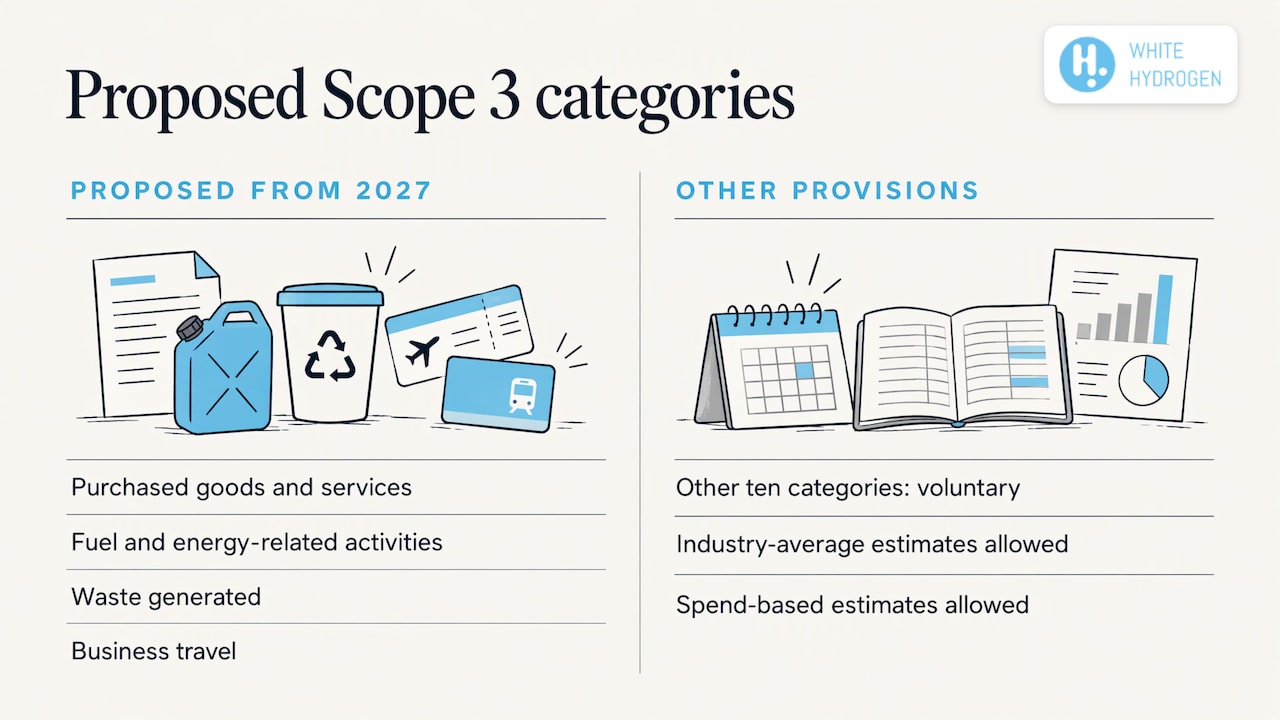
The same workshop proposal would start Scope 3 in 2027 with five GHG Protocol categories: purchased goods and services, fuel and energy-related activities, waste generated, business travel and employee commuting. The other ten categories would be voluntary, and industry-average or spend-based estimates would be allowed.
Whether that schedule survives depends on the severability ruling. Companies building a value-chain inventory anyway can use a guide to tracking all 15 Scope 3 categories to see how each category is typically measured.
Assurance: who checks the numbers
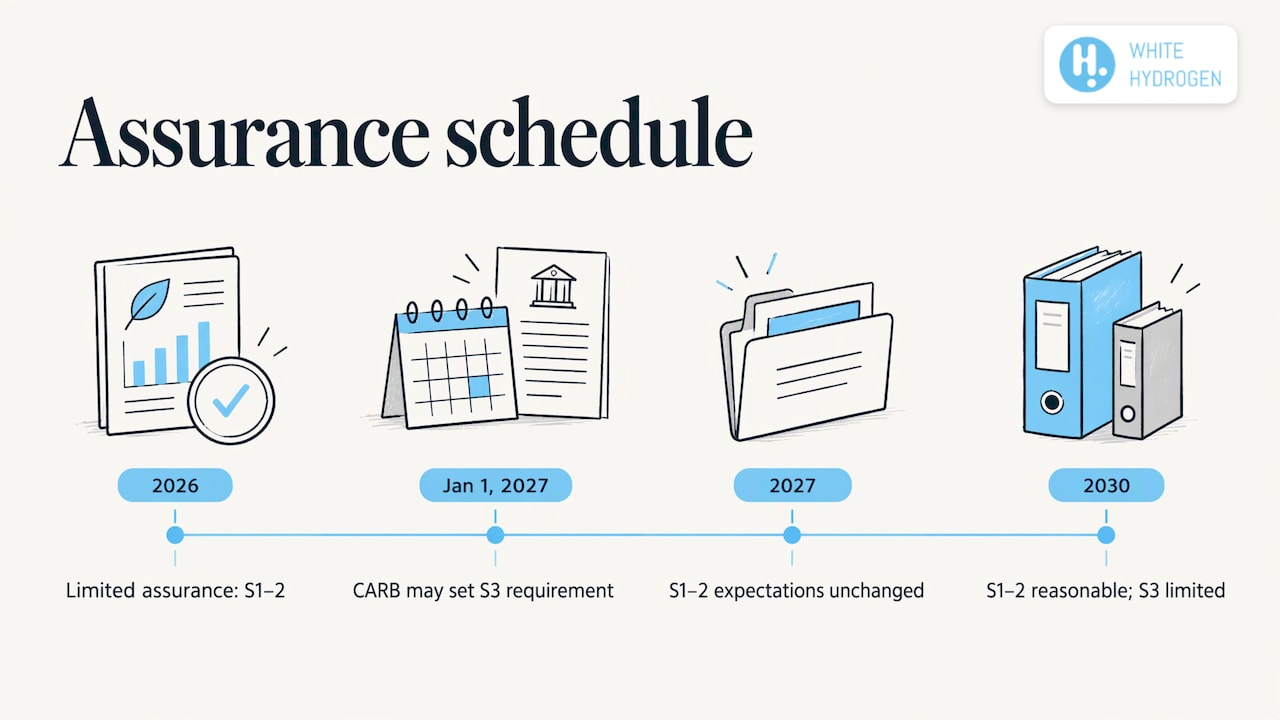
The bill text requires an independent third-party assurance engagement. Limited assurance, a lower-intensity review than a full audit, applies to Scope 1 and 2 starting in 2026 and rises to reasonable assurance in 2030. Scope 3 gets limited assurance beginning in 2030, and CARB may set a Scope 3 assurance requirement by January 1, 2027.
In practice, CARB said it would accept 2026 submissions whether or not assurance was obtained, as Grant Thornton notes. Kirkland & Ellis reports that the ruling did not change 2027 expectations for Scope 1 and 2 assurance.
CARB staff have proposed accepting several assurance standards, including ISO 14064-3:2019, AICPA attestation standards and the ISAE and ISSA families, to widen the pool of eligible providers, according to Weil. An assurance report would state the standard used, the level, the emissions covered, the conclusion, the provider and the completion date.
The lesson for anyone in the supply chain: assurance providers want data that is traceable to its source. Records that show where a figure came from are far easier to verify than a spreadsheet estimate.
Fees and penalties
Two money items apply to covered entities.
Annual fees. Weil’s Q&A explains that fees are flat per-entity amounts, calculated by dividing the program’s administration and implementation costs by the expected number of in-scope entities. They are assessed by December 10, 2026 and each December 10 after that, with payment due within 60 days of the fee notice. Thompson Coburn adds that fees may be consolidated at the parent company level.
Penalties. Under the bill text, administrative penalties may not exceed $500,000 per reporting entity in a reporting year. CARB must consider past and present compliance and any good-faith measures to comply. Scope 3 misstatements made with a reasonable basis and disclosed in good faith are not penalized, and between 2027 and 2030 Scope 3 penalties apply only for nonfiling.
What this means for clean energy producers and local projects
Most waste-to-energy facilities, local renewable developers and community organizations are far below $1 billion in revenue. They are not directly covered. But Grant Thornton observes that entities below the threshold or outside California still benefit from knowing the law, because covered companies are likely to send information requests down their value chains.
That shapes how different readers should think about it:
- Clean energy producers and facility operators: your customers’ Scope 2 and Scope 3 numbers depend on your output. Production data that is measured consistently and verifiable is what they will want to receive.
- Local organizations and project developers: a documented, quantified emissions benefit makes a project easier to explain to larger partners.
- Environmental advocates: the Scope 1 and 2 filings CARB collects make corporate emissions public, which gives you a common reference point.
- Investors in green technology: the law raises the profile of verified emissions data across the market. This is context, not investment advice.
A practical preparation routine
CARB’s stated expectation for 2026, as relayed by Weil, was that entities make a good-faith effort to retain all data relevant to emissions reporting for the prior fiscal year and give CARB what they have. The same discipline works for suppliers:
- Define your boundary. List the facilities, vehicles and purchased energy that make up your operations.
- Collect activity data at the source. Meter readings, fuel logs and production records beat estimates.
- Choose a protocol. The GHG Protocol is the basis CARB points to for future reporting.
- Keep an audit trail. Retain the records a third party would need to verify each figure.
- Prepare for customer requests. Decide who answers them and in what format.
Any official figure you rely on should be confirmed on CARB’s own pages, and questions about whether a specific entity is covered belong with your attorney.
How White Hydrogen fits
The White Hydrogen Coalition runs an open platform where clean energy producers and facilities that turn waste into green hydrogen and other sustainable energy can connect, measure their impact and verify it. Our approach pairs blockchain-based production tracking with verified production processes, so results are transparent and quantifiable. That is the kind of traceable record that emissions reporting, whether your own or a customer’s, depends on.
We also offer a blockchain-based crowdfunding tool that helps local green energy plant projects raise funds while tracking their environmental impact. If you operate or develop a facility and want measured, verifiable results behind your numbers, see the WH2C platform.
This page is general information about the platform and does not constitute advice on SB 253 compliance.
FAQ
What is the revenue threshold for SB 253?
SB 253 covers business entities with total annual revenue above $1 billion that do business in California. Revenue is determined from the prior fiscal year, and Grant Thornton reports the Initial Regulation uses the lesser of the two previous fiscal years. Private companies are covered on the same terms as public ones.
Does SB 253 require assurance?
Yes. The bill requires independent third-party assurance: limited for Scope 1 and 2 from 2026, reasonable from 2030, and limited for Scope 3 from 2030. For the first 2026 report, CARB said it would accept submissions with or without assurance.
What is the status of SB 253 after the Ninth Circuit ruling?
The Scope 1 and 2 requirements proceed. The court found the Scope 3 requirement and SB 261 likely unconstitutional and sent the Scope 3 severability question to the district court. Watch CARB announcements and the court docket for updates.
How do companies file an SB 253 report?
For 2026, CARB accepted an existing report, data already submitted to other programs, or its voluntary template. Filers could use CARB’s voluntary intake platform or email climatedisclosure@arb.ca.gov. Future years are expected to bring more detailed, GHG Protocol-based requirements.
Sources
- California Corporate Greenhouse Gas Reporting, CARB bulletin
- SB253 Informational Board Hearing, October 22, 2026
- Guidance for SB 253 2026 Reporting
- Updated Informative Digest
- SB 253 bill text, California Legislative Information
- SB 253 enrolled text
- Sidley: SB 253/SB 261 Ninth Circuit update
- White & Case: Ninth Circuit and SB 253 Scope 3
- Kirkland & Ellis: Ninth Circuit ruling
- Regbase: SB 253 and SB 261 tracker
- Grant Thornton: California climate reporting bills
- Weil: Climate Disclosure Whiplash Q&A
- Thompson Coburn: compliance deadlines post-Sanchez
- Guide to tracking all 15 Scope 3 categories
More articles

Carbon Management Software: What It Does and How to Choose
Carbon management software explained for clean energy producers, local groups and investors: what it tracks, how to judge it, and why verified data matters most.

Green Hydrogen Production: How It Works and What It Takes
How green hydrogen is produced from renewable power and water: electrolyzer types, efficiency, costs, water needs and what makes a project work at scale.
Sustainability Data Platform: What It Does and How to Choose
A sustainability data platform collects, verifies and reports environmental data. See what it tracks, how it validates output and how to pick one for your site.