Carbon Negative Meaning: What It Is and How to Verify It
Carbon negative means that an organization, product or activity removes more carbon dioxide from the atmosphere than it emits. The Cambridge Dictionary defines it in just these terms. A credible claim also names a period, counts only removals that match the emissions they offset, and can be checked by someone outside the company. That last point is why verified production data matters, and it is the reason we build the White Hydrogen Coalition platform around measurement and blockchain-based tracking for clean energy facilities.
TL;DR
- Carbon negative means removals exceed emissions, so the activity leaves less CO₂ in the atmosphere than it found.
- Carbon neutral and net zero mean emissions are balanced by removals. Carbon negative goes one step further.
- A trustworthy claim states a declared period, uses like-for-like removals, avoids double counting and rests on verified data.
- Removal complements emission cuts. It does not replace them.
- For clean energy producers, verified and traceable production data is what turns an environmental promise into a result others can check.
Table of Contents
- What carbon negative means in plain terms
- Carbon negative, carbon neutral, net zero and carbon positive
- How an activity can become carbon negative
- How to check whether a carbon-negative claim holds up
- Why verified data decides the outcome
- Where the White Hydrogen platform fits
- What this means for your next step
- FAQ
- Sources
What carbon negative means in plain terms
Every organization, product or activity has a carbon footprint: the greenhouse gases released by making it, running it and, in some accounting methods, using it. Some activities also take carbon out of the air. Trees absorb it, certain soils hold it, and engineered systems capture it and store it underground.
When the carbon taken out exceeds the carbon put in, the result is carbon negative. The British Ecological Society glossary frames it as going beyond net zero: it removes more carbon from the atmosphere than is emitted. You will also see the terms “net negative” and “climate positive” used for the same idea. The World Resources Institute explains that net negative occurs when annual CO₂ removals exceed residual emissions, which reduces the CO₂ that has accumulated in the atmosphere.
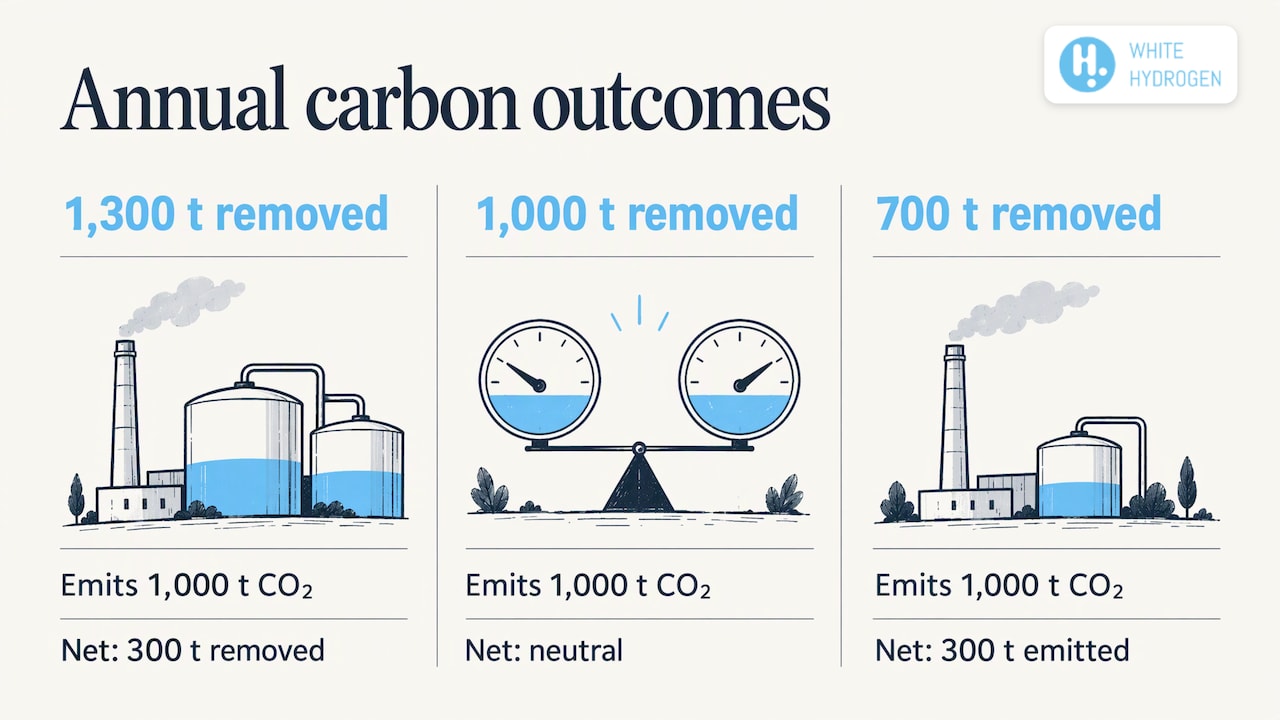
A simple worked example shows the logic. Suppose a facility emits 1,000 tonnes of CO₂ in a year and, through verified removal, takes 1,300 tonnes out. Its net result is 300 tonnes removed, so it is carbon negative for that year. If it removes only 1,000 tonnes, it is neutral. If it removes 700, it is still adding 300 tonnes to the atmosphere. The numbers are illustrative, but the arithmetic is the whole concept.
Two details that change the answer
The first is the period. The Net Zero Guidebook from The Climate Drive says a carbon-negative pledge should state a declared period and whether emissions and removals are cumulative or counted only within that period. A plant that was negative last year but has no stated boundary is making a slogan, not a measurable claim.
The second is that removals must be like for like with the emissions they balance. The same guidebook uses that phrase for pledges: the removals counted against emissions need to be comparable in kind, not a loose stand-in.
The WRI adds that in its accounting discussion, net-negative removal means deliberate, human-driven removal, not natural carbon exchanges such as the ocean absorbing and releasing CO₂.
Carbon negative, carbon neutral, net zero and carbon positive
These terms are often mixed up, and the confusion is part of why claims need scrutiny.
| Term | What it says | Where it sits |
|---|---|---|
| Carbon positive | Emits more than it removes | Adds to atmospheric CO₂ |
| Carbon neutral | Emissions balanced by equivalent removals or offsets | Neither adds nor reduces |
| Net zero | Residual emissions balanced by removals after deep cuts | Neither adds nor reduces |
| Carbon negative | Removals exceed emissions over a stated period | Reduces atmospheric CO₂ |
The International Energy Agency separates carbon neutrality or net zero, where emissions are balanced by equivalent removals, from carbon negative, which removes more CO₂ than is emitted.
Carbon neutral and net zero overlap, but they are not identical for a single company. According to the IPCC’s AR6 Working Group III FAQ on this question, the two are equivalent at the global scale. For smaller entities, net zero generally refers to direct control or territorial responsibility, while neutrality is also applied to firms, products and activities and can include value-chain emissions. The same FAQ warns that “carbon neutrality” is ambiguous in practice: the IPCC report definition refers to CO₂, but some users mean all greenhouse gases.
MIT Climate Portal makes a related point: carbon neutrality and net-zero carbon emissions concern CO₂, whereas net-zero emissions must also account for methane, nitrous oxide and fluorinated gases. So before comparing two claims, check which gases each one counts.
What about a zero carbon footprint?
A zero carbon footprint is usually used to describe a balance: nothing left over after reductions and removals. It sits at the neutral line. Carbon negative is the step beyond it, where the balance tips in the atmosphere’s favor. Because “zero” is used loosely in marketing, apply the same checks below to it as to any other claim.
How an activity can become carbon negative
The IEA lists several routes: reforestation, soil-carbon enhancement, bioenergy with carbon capture and storage (BECCS), and direct air capture. In BECCS, plants grow and absorb CO₂, are converted to energy, and the CO₂ released in that process is captured and stored. Direct air capture pulls CO₂ straight from ambient air with engineered equipment.
The IEA is clear about the context. Carbon removal is not an alternative to cutting emissions, and it should not be a reason to delay reductions. Its role is to address residual emissions that are technically difficult or prohibitively costly to eliminate. The IEA also points to practical challenges, including sustainable biomass availability, missing transport and storage infrastructure, and the need for more research on some approaches.
The IPCC’s FAQ on reaching net zero adds a distinction that is easy to miss. Carbon dioxide removal can neutralize residual emissions to reach net zero, but deploying removal is not the same thing as achieving net-negative CO₂ emissions. Removal becomes negative only when the total removed is larger than the total emitted.
Permanence matters
Not all removal lasts equally long. A 2024 handbook from Carbon Market Watch notes that land-based carbon stores can be lost through human and natural disturbances and require ongoing management, so they are best seen as temporary storage. The same handbook says geological storage has lifetimes of over 100,000 years, while biological sinks carry a higher risk of reversal. When a claim depends on stored carbon, ask how long it stays stored and who monitors it.
Some building-level measures also reduce a site’s footprint. Green roofs and their advantages are one example of how the built environment is being rethought as part of broader sustainability planning.
Avoided emissions are not removals
Emissions you did not release are not the same as carbon you took out of the air. The ISO 14068:2026 standard text, in its published sample, places avoided emissions outside its carbon-neutrality accounting approach, though they may support a wider climate strategy. That is why a project that replaces fossil fuels is valuable, but it does not by itself make a carbon-negative claim.
How to check whether a carbon-negative claim holds up
For producers, local organizations, activists and investors alike, the useful skill is reading a claim. Work through these questions in order.
- Is there a declared period? A claim without a start and end date cannot be tested. The Net Zero Guidebook asks for the period and whether figures are cumulative.
- Are removals like for like? Counted removals should correspond to the emissions they are set against, as the guidebook states.
- Is the footprint measured to a recognized method? According to the ISO 14068:2026 sample, a product’s footprint is based on life-cycle assessment under ISO 14067, while an organization’s footprint covers direct and indirect emissions and removals within its boundary, quantified under ISO 14064-1.
- Was it verified independently? The same standard describes ISO 14064-3 as setting verification requirements for greenhouse gas statements, and ISO 14065 as setting requirements for the impartiality and competence of verification bodies, in a preview of the standard.
- Is any offset free of double counting? The IPCC says environmental-integrity criteria for offsets are meant to ensure additionality, meaning the reduction would not have happened anyway, and to prevent double counting. The UK Parliament’s science office explains double counting as the case where both the credit seller and the buyer claim the same offset to report lower net emissions.
- Is the claim specific? Guidance on verifiable sustainability claims says claims should be fact-based, correct and verifiable, and not vague, misleading or unsupported by a credible method or certification scheme. It also says primary data should be available to a verifier, and that secondary data should come with a substantiated uncertainty estimate.
The ISO Net Zero Guidelines point the same way, describing transparent communication, credible claims and consistent reporting on emissions, reductions and removals as the common approach.
Why verified data decides the outcome
Look at the six questions again. Almost all of them come down to data: what was produced, what was emitted, what was removed, when, and who confirmed it. A facility that cannot show those numbers cannot make a carbon-negative claim that stands up, however good the technology.
This is the gap the White Hydrogen Coalition works on. We focus on clean energy technologies that turn waste into green hydrogen and other sustainable energy sources, and we have built an open platform where different green energy producers can connect, measure their impact and work toward lower carbon footprints. Our approach combines blockchain technology with verified production processes, so results are transparent and quantifiable.
For a producer, that means production records that can be traced and shown to the people who ask about them. For a local organization or an investor evaluating a green project, it means a clearer view of what a facility actually does. For an activist, it means the conversation can move from promises to measured figures.
Where the White Hydrogen platform fits
Our platform gives clean energy producers and facilities a place to connect, measure and verify their impact in converting waste into green hydrogen and other sustainable energy. It includes blockchain-based production tracking, a carbon footprint reduction ecosystem, and a crowdfunding solution for green energy plant projects. Our blockchain-based crowdfunding tool is designed to help local projects access funding while keeping their environmental impact quantifiable.
If you operate a facility or develop a project and want your results to be measurable and open to verification, you can find out more about the WH2C platform.
The platform is built for facilities, operators and project developers. It supports multiple renewable technologies, which means a waste-to-hydrogen site and another type of green producer can sit in the same network and be measured the same way.
What this means for your next step
A few practical takeaways, depending on who you are:
- Producers and operators: decide your boundary and period first, then collect primary data on emissions and any removals. Both are needed before the word “negative” can be used.
- Local organizations: ask any project partner for the period, the method and the verification route behind its figures.
- Activists: use the six questions above to separate a quantified result from a slogan.
- Investors: treat a carbon-negative statement as a claim about data, and look at how that data is produced and verified. This article does not offer investment, legal or tax advice, so take those questions to a qualified adviser.
Carbon negative is a high bar, and it should be. The bar is what makes it meaningful: a result that cuts more from the atmosphere than an activity adds, shown with numbers that someone else can check.
FAQ
What does carbon negative mean?
It means an organization, product or activity removes more CO₂ from the atmosphere than it emits. The result is a net reduction in atmospheric carbon over a stated period. Other terms for it include net negative and climate positive.
Is carbon negative better than carbon neutral?
In terms of atmospheric impact, yes. Carbon neutral balances emissions with equivalent removals, so nothing is added or taken away. Carbon negative removes more than it emits, so it leaves the atmosphere with less CO₂.
Is carbon negative the same as net zero?
No. Net zero means residual emissions are balanced by removals after deep cuts. Carbon negative goes beyond that point, with removals exceeding emissions. Net zero can also cover all greenhouse gases, not just CO₂, so check which gases a claim counts.
Does being carbon negative mean no emissions?
No. A carbon-negative operation can still emit greenhouse gases. What defines it is that its measured removals are larger than those emissions over the declared period. The IEA stresses that removal should complement emission cuts, not replace them.
How can I tell if a carbon-negative claim is credible?
Look for a stated period, like-for-like removals, a recognized measurement method, independent verification and no double counting. A claim that offers none of these gives you little to test.
Sources
- CARBON-NEGATIVE definition | Cambridge English Dictionary
- The BES glossary of environmental terms
- What Are Net-Negative Emissions? | World Resources Institute
- Net Zero-comparable climate pledges | Net Zero Guidebook
- Going carbon negative: What are the technology options? | IEA
- IPCC AR6 WGIII FAQ 1.3
- IPCC AR6 WGIII FAQ 3.2
- Net Zero Emissions | MIT Climate Portal
- CDR carbon-negative handbook | Carbon Market Watch
- ISO 14068:2026 sample
- ISO 14068:2026 preview
- Carbon offsetting | UK Parliament POST briefing
- Verifiable Sustainability Claims
- ISO Net Zero Guidelines
More articles
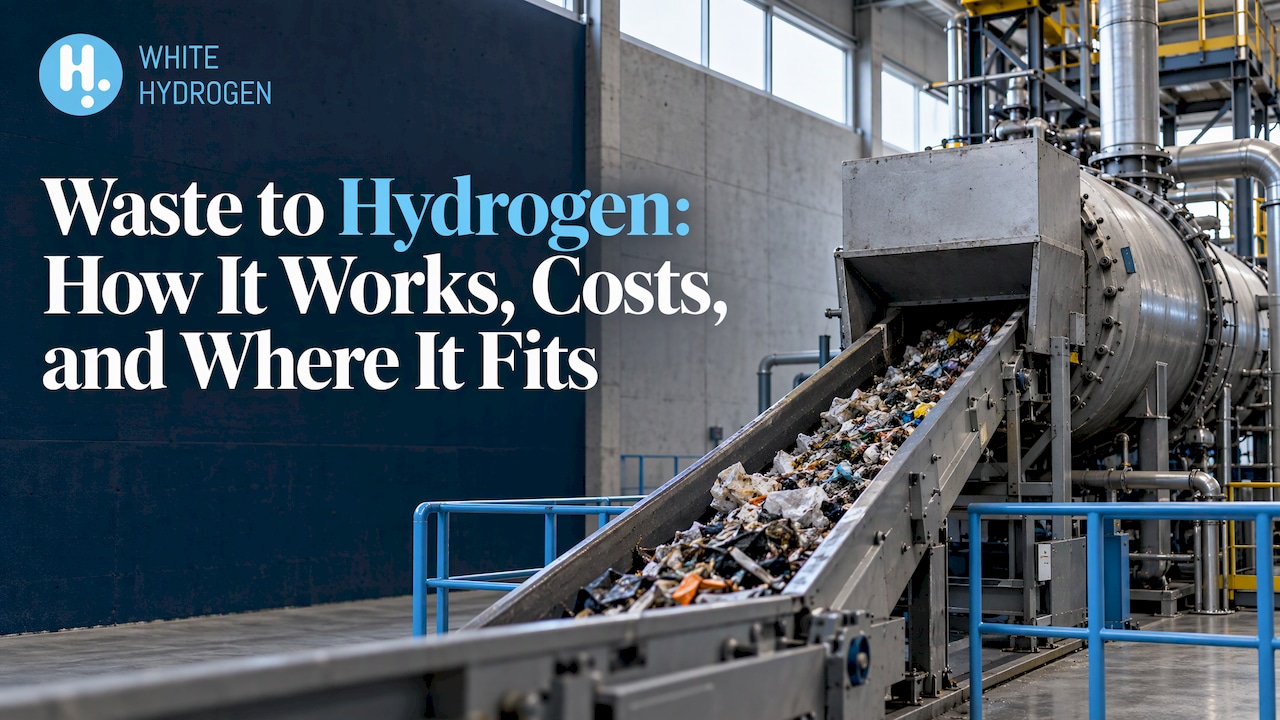
Waste to Hydrogen: How It Works, What It Costs, and Where It Fits
How waste becomes hydrogen: feedstocks, thermochemical and biological routes, lifecycle emissions, costs and what producers and project backers should weigh.

Renewable Energy Integration: How Grids Absorb Solar and Wind
Renewable energy integration explained: what it means, why variable solar and wind strain grids, what it costs, and where waste-to-hydrogen producers fit in.

California SB 253 Explained: Who Reports, What and When
SB 253 explained: who must report, the $1 billion threshold, Scope 1, 2 and 3 timing, assurance, penalties and what the Ninth Circuit ruling changed.