Waste to Hydrogen: How It Works, What It Costs, and Where It Fits
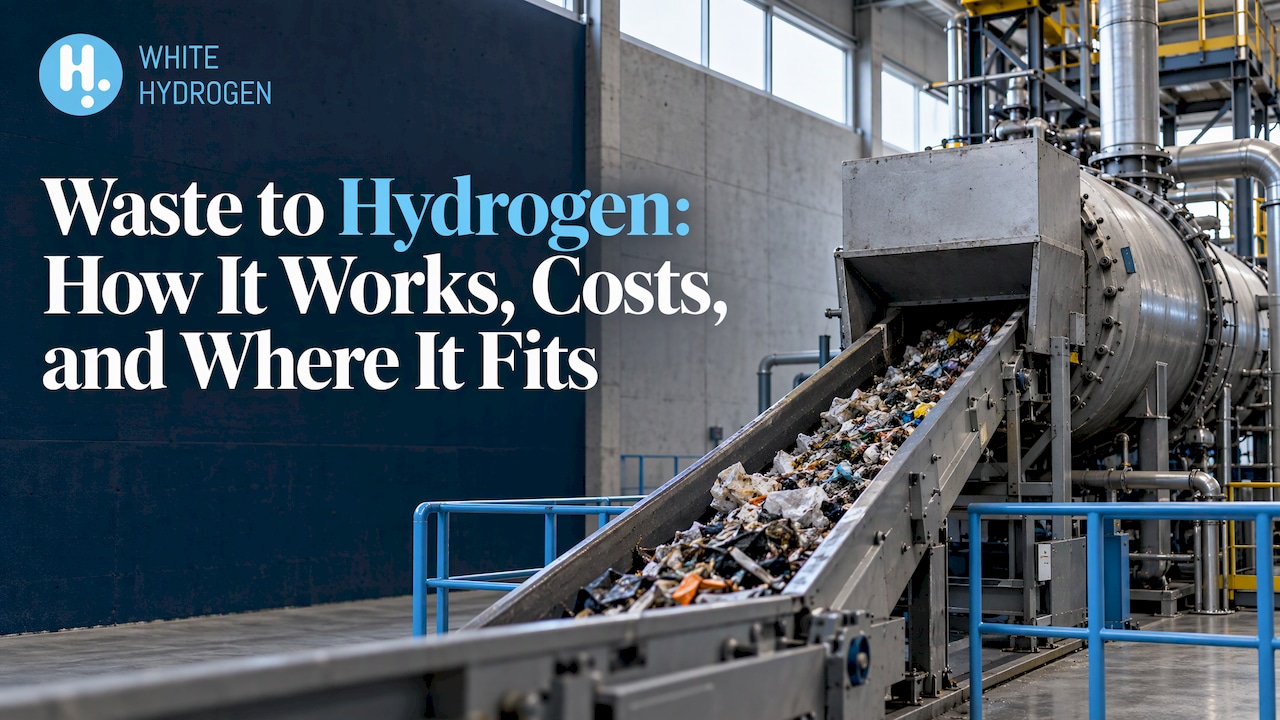
Waste-to-hydrogen means turning plastics, municipal solid waste, food waste, agricultural residues or organic wastewater into hydrogen gas, either by heating the waste in a controlled reactor or by letting microbes digest it. The process is real and moving toward commercial scale, but results depend on feedstock supply, the power source and the plant’s design. Projects that can measure and verify what they produce are the ones that earn trust from funders and communities. That is the gap White Hydrogen’s platform addresses: it connects clean energy facilities and records their production and impact on a blockchain-based tracking system.
TL;DR
- Waste becomes hydrogen by two main families of processes: thermochemical (gasification, pyrolysis) and biological (fermentation, microbial electrolysis).
- Lifecycle emissions in one 2025 review were about 3.5 kg CO2-eq per kg of hydrogen for plasma and hydrothermal gasification of waste, against about 10.5 for steam methane reforming.
- Costs vary widely by route and site. Feedstock supply, capital cost and by-product revenue drive the business case.
- Verified production data and transparent impact measurement help local projects explain what they deliver to funders and communities.
Table of Contents
- What counts as waste-to-hydrogen
- How waste becomes hydrogen, step by step
- How much hydrogen a tonne of waste yields
- Emissions and environmental footprint
- Costs and project economics
- Where waste-to-hydrogen fits
- Making the impact measurable
- A practical checklist for evaluating a waste-to-hydrogen project
- FAQ
- Sources
What counts as waste-to-hydrogen
Hydrogen can be made from fossil fuels, from water using electricity, or from waste. The waste route treats discarded material as the raw ingredient. Two things happen at once: you get a fuel, and you divert material from landfill or incineration.
The feedstocks fall into three practical groups:
- Dry, solid waste. Mixed plastics, the plastic and organic fractions of municipal solid waste (MSW, the everyday trash collected by cities), tires and dry biomass such as wood residues. These suit heat-based processes.
- Wet biowaste. Food waste, manure, sewage sludge and crop residues with high moisture. A 2025 MDPI systematic review points to hydrothermal gasification and dark fermentation as particularly promising for wet biowaste streams like food waste.
- Organic wastewater. Food-processing and some municipal effluents carry chemical energy that microbes can turn into hydrogen. Research on food wastewater in microbial electrolysis cells shows the approach, along with the practical hurdle: complex, solids-heavy wastewater usually needs pre-treatment before it can feed the cell.
The type of waste decides the technology, so a project starts with a feedstock audit: what is available, how much, how consistent, and at what cost or revenue.
How waste becomes hydrogen, step by step
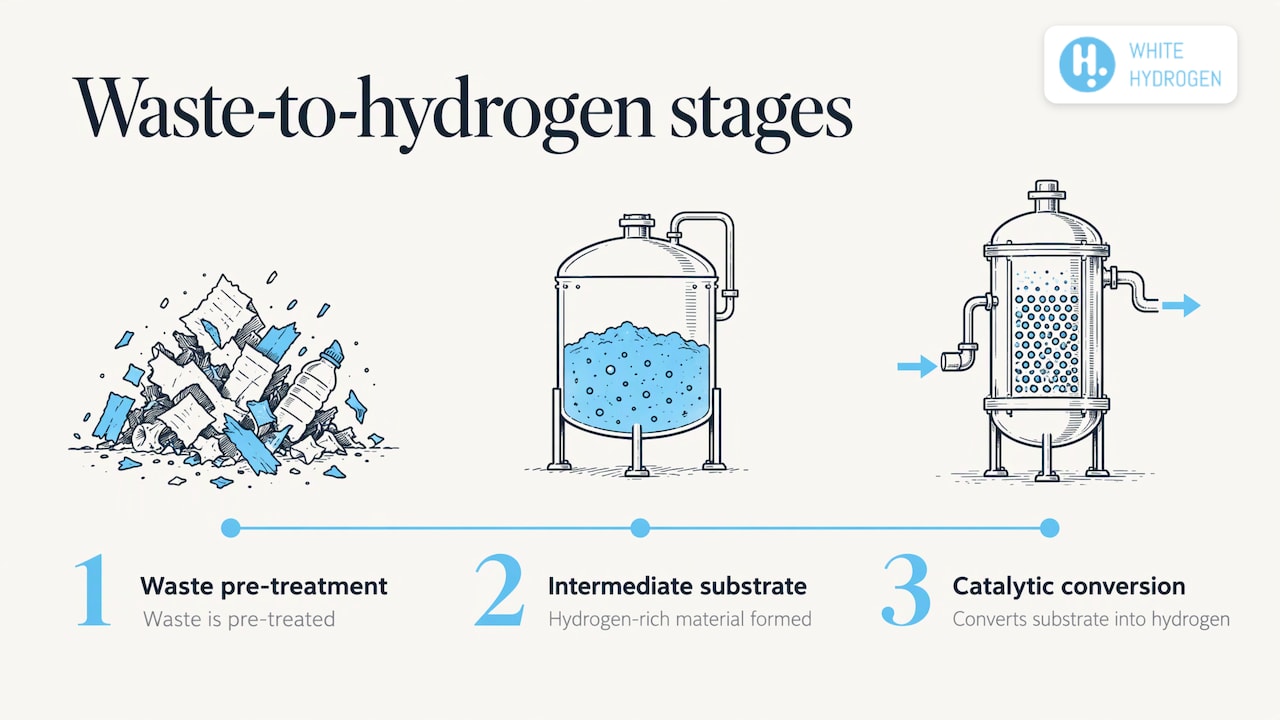
An MDPI chapter by Hren and colleagues (2025) describes the general sequence: waste is pre-treated, converted into an intermediate hydrogen-rich substrate, then converted to hydrogen catalytically. Here is what each stage involves.
1. Pre-treatment
Drying and impurity removal raise the energy density of the waste and make its properties more uniform. This matters more than it sounds. The IEA Greenhouse Gas R&D Programme notes that variable feedstock quality raises the cost of hydrogen, and that pre-treatment such as torrefaction (mild roasting of biomass) is increasingly used to standardize feedstock.
2. Conversion to a hydrogen-rich gas
This is where the routes split.
Thermochemical routes use heat. Gasification partially oxidizes the waste with air, steam or oxygen to make syngas, a mix of hydrogen, carbon monoxide, methane and CO2. A 2026 review of waste-to-hydrogen hubs puts gasification at 700 to 1,000 °C and thermochemical technologies at technology readiness levels 6 to 8. Pyrolysis heats waste without oxygen, producing gas, oil and char. Plasma gasification uses very high temperatures for mixed or hazardous waste.
Biological routes use microorganisms. Dark fermentation, photofermentation, microbial electrolysis and hybrids work at ambient temperature and pressure. According to the Hren chapter, thermochemical processes are faster and give higher hydrogen yields and can handle a wider range of feedstocks, while biochemical processes use less energy but yield less hydrogen and run more slowly.
Wet waste is often routed through anaerobic digestion first, producing biogas that can be reformed into hydrogen.
3. Upgrading and purification
The raw gas is not yet usable hydrogen. Thermochemical routes produce carbon monoxide and methane, which are upgraded through steam reforming and the water-gas shift reaction (CO plus water gives CO2 plus more hydrogen). The MDPI review describes a typical chain: syngas from gasification at 800 to 1,400 °C, sulfur and tar removed with catalysts, then CO2 removed by pressure-swing adsorption to reach up to 99.9% hydrogen purity.
4. Handling the residues
Char, ash and captured CO2 need a plan. The IEA study found that incineration-based pathways have the greatest terrestrial ecotoxicity impact because of char and ash disposal, while pyrolysis and gasification are among the most environmentally favorable routes across most categories.
How much hydrogen a tonne of waste yields
Yields depend on what goes in and how the plant is built. Some published figures:
- A 2026 study of Oman’s plastic waste infrastructure reports that pure polymers achieve 120 to 250 kg of hydrogen per tonne, while real mixed plastic waste produces 140 to 214 kg per tonne with optimized three-stage processing.
- The IEA study estimates gasification needs about 23 kg of MSW per kg of hydrogen, pyrolysis about 25 kg, incineration with electrolysis about 80 kg and dark fermentation about 143 kg.
- The 2026 hub review reports gasification systems with downstream upgrading reaching roughly 40 to 80 g of hydrogen per kg of feedstock.
Those numbers are not interchangeable. They come from different feedstocks, system boundaries and assumptions. For a project, the lesson is to base planning on measured output from your own feedstock, not on the best figure in a paper.
One more point on chemistry: among biomass components, lignin is the biggest contributor of hydrogen, while cellulose and hemicellulose yield more methane and carbon monoxide. A woody residue and a sugary food waste behave differently in the same reactor.
Emissions and environmental footprint
The climate case is the main reason waste-to-hydrogen draws interest. The June 2025 MDPI review gives lifecycle greenhouse gas figures per kg of hydrogen:
| Production route | kg CO2-eq per kg H2 |
|---|---|
| Coal gasification | about 19 |
| Electrolysis on grid electricity | about 14 |
| Steam methane reforming | about 10.5 |
| Plasma or hydrothermal gasification of MSW or wet biomass | about 3.5 |
| Biological routes (dark fermentation, photofermentation, microbial electrolysis) | 0.7 to 2.5 |
| Renewable-powered electrolysis | about 1 |
Source: MDPI systematic review of hydrogen production from biowaste, 2025.
Three factors move these results.
Electricity source. The 2026 hub review stresses that lifecycle performance is determined largely by the power used for preprocessing, gas cleanup and compression. It recommends comparing carbon-intensive grid, average grid and dedicated renewable cases separately.
Avoided landfill methane. Methane that would have escaped from a landfill is commonly counted as a credit in lifecycle assessments, and the assumption materially changes results. The Oman study estimates that landfill diversion avoids about 500 kg CO2-eq per tonne of waste.
Water. The same hub review reports water footprints of 6 to 9 liters per kg of hydrogen for thermochemical pathways, and notes that biochemical pathways use less water but may need dedicated land if feedstock crops are involved.
The practical takeaway: an emissions claim is only as strong as the data behind it. Facilities that log feedstock, energy inputs and hydrogen output through a verified process can state their footprint with numbers, not assumptions.
Costs and project economics
Cost is where waste-to-hydrogen needs the most careful reading, because published ranges are wide. All figures below are from studies for specific technologies, sites and years, not quotes.
The 2025 MDPI review’s technoeconomic table gives levelized cost of hydrogen (LCOH, the average cost per kg over a plant’s life) of:
- Biomass gasification: USD 2.5 to 4.0 per kg
- Pyrolysis: USD 3.0 to 4.5 per kg
- Hydrothermal gasification: USD 4.0 to 6.0 per kg
- Plasma gasification: USD 5.5 to 7.0 per kg
- Microbial electrolysis cells: USD 5.0 to 6.5 per kg
In the same review, steam methane reforming remains the cheapest baseline at USD 1.0 to 2.0 per kg.
Site-specific modeling can look better. The Oman study finds plastic waste gasification producing 21,997 tonnes of hydrogen a year at $2.88 per kg, processing 275,000 tonnes of plastic waste, though feedstock availability limits output to 24% of base demand. A simulation of a 2,000 kg/h mixed-plastic pyrolysis and reforming plant reported 651.2 kg/h of hydrogen at 99% purity, a 39% internal rate of return and a payback of 5.95 years. Simulations show what is possible under stated assumptions; they are not forecasts for your site.
The IEA study looked at waste-to-hydrogen with carbon capture and storage and found a cost of US$5.15 to 14.91 per kg, with viability hinging on waste cost, consistent availability and quality.
What drives the business case
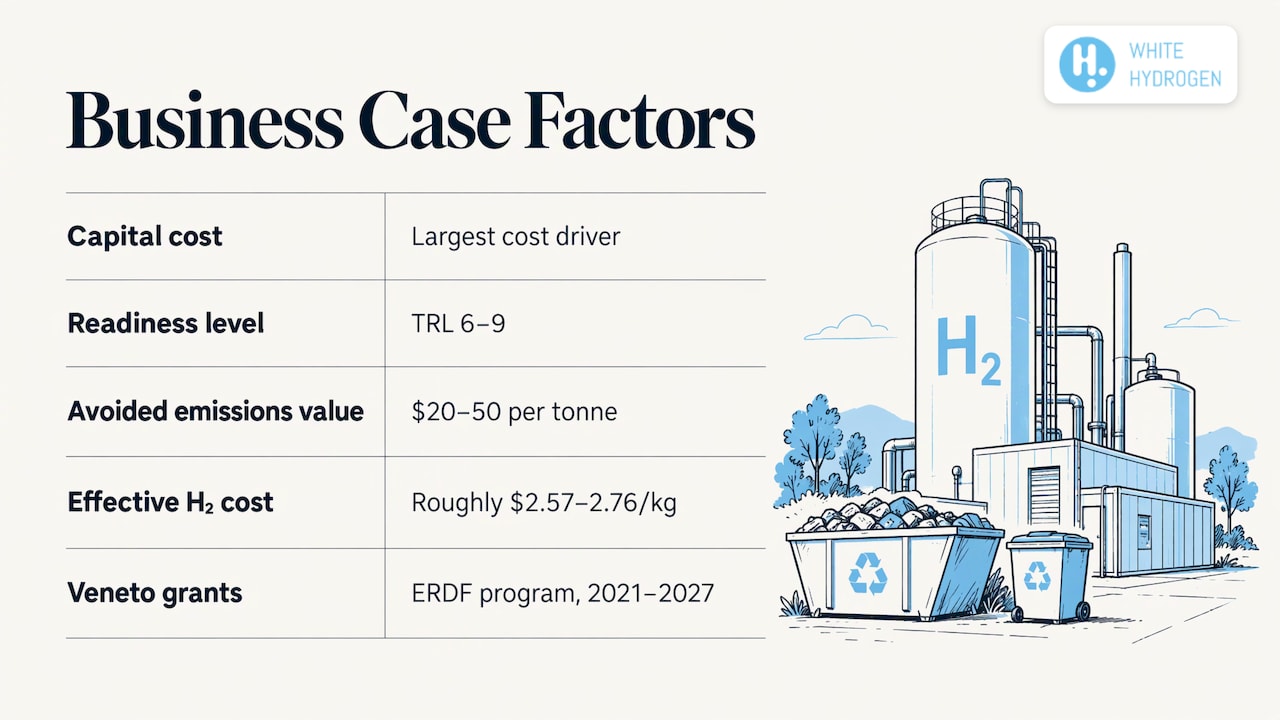
Hydrogen Europe’s 2024 production pathways report identifies capital cost as the largest cost driver for both waste-to-hydrogen technologies, with significant potential to decrease. It adds that the business case rests on feedstock cost or revenue, by-product revenue and CO2 transport and storage costs. The same report rates waste-based routes at technology readiness levels 6 to 9.
A waste-to-hydrogen project is not just a hydrogen business. It can earn gate fees for taking waste, sell by-products such as char or carbon black, and in some markets earn carbon credits. The Oman study estimates that valuing avoided emissions at $20 to 50 per tonne would bring effective hydrogen costs down to roughly $2.57 to 2.76 per kg. The author concludes waste-to-hydrogen works best as a complement to other hydrogen routes.
Public money also shapes the capital side. Regional programs such as the renewable hydrogen funding calls under Veneto’s 2021 to 2027 regional ERDF program show how grants can offset part of the investment for qualifying projects. Eligibility rules differ by country and program, so check the issuing authority’s current terms.
Where waste-to-hydrogen fits
Waste-to-hydrogen will not replace electrolysis or natural gas reforming everywhere. It fits where three conditions meet:
- A steady, local waste stream. Hauling distance and supply reliability matter as much as the reactor.
- A nearby hydrogen or energy user. Industrial sites, fleets or local grids that can take the output.
- A way to prove impact. Funders, buyers and regulators want evidence of tonnes diverted, energy used and emissions avoided.
The third condition is where many promising projects stall. A plant can have sound engineering and still struggle to convince a lender or a neighborhood because its numbers are self-reported and scattered across spreadsheets.
Making the impact measurable
This is the problem White Hydrogen works on. The White Hydrogen Coalition promotes clean energy technologies that transform waste into green hydrogen and other sustainable energy sources. It runs an open platform where different green energy producers can connect their facilities, measure their impact and work to cut their carbon footprints. Its approach combines blockchain technology with verified production processes, so results are transparent and quantifiable.
For a waste-to-hydrogen operator, that means the figures discussed above, such as feedstock processed, output and avoided emissions, can sit in a shared, verifiable record instead of a private report. For local organizations and investors weighing a project, it means a clearer view of what a plant actually does.
The Coalition has also built a blockchain-based crowdfunding platform that helps local projects raise funds for green energy plants while tying them to quantifiable environmental results. Producers, facility operators and project developers can learn more about the WH2C platform at whiteh2coin.com.
This article is general information on technology and project economics. It is not investment, legal or tax advice, and project decisions should involve qualified engineers and advisers.
A practical checklist for evaluating a waste-to-hydrogen project
Whether you operate a facility, sit on a local development board or follow the sector as an advocate or investor, these questions separate solid projects from optimistic ones:
- Feedstock: What is the waste, how much is contracted, and how variable is its quality?
- Technology readiness: Is the chosen route proven at the planned scale? The reviews above place thermochemical technologies at TRL 6 to 8.
- Energy inputs: Where does the electricity for preprocessing, cleanup and compression come from?
- Residues: How are char, ash and captured CO2 handled?
- Revenue stack: Are gate fees, by-products and carbon credits modeled separately from hydrogen sales?
- Measurement: Which outputs and emissions will be recorded, by whom, and how can others check them?
FAQ
Can hydrogen be made from wastewater?
Yes. Microbial electrolysis cells and fermentation use microbes to turn organic matter in wastewater into hydrogen. Food-processing effluent is a common research subject, and solids-heavy streams usually need pre-treatment first, as in this food wastewater study. Biological routes have low emissions in lifecycle studies but lower yields than thermochemical ones.
Is hydrogen from waste green?
That depends on how it is made and which definition applies. Lifecycle results in the 2025 MDPI review range from 0.7 to 2.5 kg CO2-eq per kg for biological routes to about 3.5 for gasification of waste, and electricity source and landfill methane assumptions shift them. Definitions of “green” and “low-carbon” hydrogen differ by country, so check the standard that applies where you operate.
What is the most mature technology for turning waste into hydrogen?
Gasification and pyrolysis are the most developed thermochemical options, with the 2026 hub review placing thermochemical conversion at technology readiness levels 6 to 8. Biological routes are generally earlier stage. Maturity at pilot scale does not guarantee results at your site, so feedstock testing matters.
How much waste does it take to make a kilogram of hydrogen?
The IEA study estimates about 23 kg of municipal solid waste per kg of hydrogen for gasification and about 25 kg for pyrolysis. Other routes need much more, up to about 143 kg for dark fermentation. Plastic-rich feedstocks yield more hydrogen per tonne than mixed municipal waste.
Sources
- From Waste to Hydrogen: Utilizing Waste as Feedstock or Catalyst (MDPI, 2025)
- Hydrogen Production from Biowaste: A Systematic Review (MDPI, 2025)
- Waste-to-hydrogen (WtH2) hubs: integrated review (Taylor & Francis, 2026)
- A Critical Study on Waste to Low Carbon (CCS-Abated) Hydrogen (IEAGHG, 2025)
- Evaluation of Waste-to-Hydrogen Infrastructure in Oman (MDPI, 2026)
- Hydrogen from Waste Plastics: Integrated simulation study (MDPI, 2026)
- Clean Hydrogen Production Pathways Report 2024 (Hydrogen Europe)
- Pre-fermentation and microbial electrolysis for hydrogen from food wastewater (ScienceDirect)
More articles

Renewable Energy Integration: How Grids Absorb Solar and Wind
Renewable energy integration explained: what it means, why variable solar and wind strain grids, what it costs, and where waste-to-hydrogen producers fit in.

California SB 253 Explained: Who Reports, What and When
SB 253 explained: who must report, the $1 billion threshold, Scope 1, 2 and 3 timing, assurance, penalties and what the Ninth Circuit ruling changed.
Carbon Management Software: What It Does and How to Choose
Carbon management software explained for clean energy producers, local groups and investors: what it tracks, how to judge it, and why verified data matters most.